
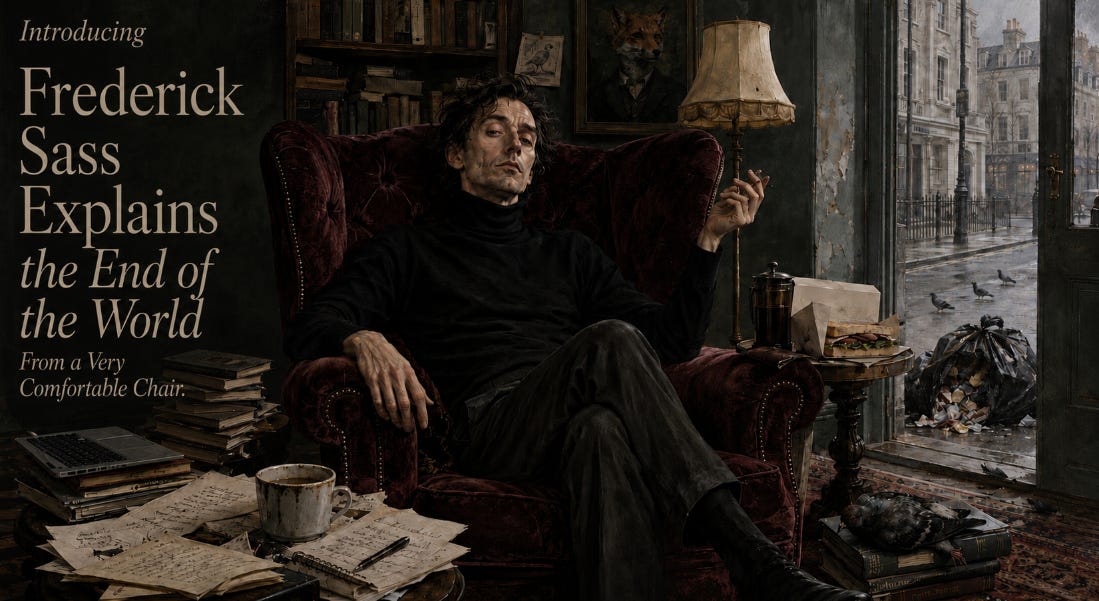
Introducing Frederick Sass
Prophet of the Paying Wound

Frederick Sass was not born Frederick Sass. Nobody is born Frederick Sass. One becomes Frederick Sass slowly, through a sequence of private humiliations, public opinions, over-boiled coffee, failed tenderness, and the gradual discovery that every personal irritation can be converted into a theory of civilisation.
There had once been, people said, a Freddie. Perhaps even a Fred. A boy with knees. A boy who liked crisps. A boy who watched television without immediately accusing it of performing the necropolitics of the family. But that boy had vanished long ago, buried under ash, adjectives, and a paywall.
In his place stood Frederick Sass: essayist, scourge, diagnostician, licensed embalmer of the present tense.
His newsletter was called The Paying Wound, though it had previously been called Meat Weather, The Black Lacuna, The Republic of Teeth, and, during an especially difficult six weeks, Against Breakfast. Every few days Frederick would descend upon some minor cultural incident, a minister’s sandwich, a novelist’s divorce, a children’s film, a badly worded apology, a photograph of a dog wearing a little coat and reveal that it was not minor at all. Nothing was minor. That was the first commandment of Sassism.
A sandwich was never a sandwich. It was empire between bread.
A queue was never a queue. It was the rehearsal of obedience.
A dog in a coat was not a dog in a coat. It was liberalism’s final, whimpering attempt to abolish the child.
Frederick had discovered early that the modern reader did not want to be informed. Information was everywhere, oozing out of screens, lift doors, cereal boxes, and the little poisoned rectangle in everyone’s hand. No, the modern reader wanted something better. They wanted to be told that their disgust was intelligent. They wanted their bad mood dressed up as historical consciousness. They wanted the thin, sour film that formed on the soul after three hours online to be revealed not as boredom, envy, or spiritual malnutrition, but as insight.
Frederick sold this beautifully.
He sold bitterness with footnotes. He sold despair in a black jumper. He sold the feeling that you, alone among the medicated herd, had seen the corpse under the dinner table.
His subscribers came to him for the old magic. They brought him the things they hated property developers, dating apps, centrist columnists, brunch, therapy-speak, men who say “wellness,” women who say “holding space,” anyone who had ever described a workplace as a family and Frederick transfigured them. He lifted each irritation to the altar, slit its throat, and read the entrails. Behold, he would say. The West.
It was always the West.
More specifically, it was always the West dying, although the West had been dying for so long under Frederick’s supervision that one began to suspect it enjoyed the attention. In his prose, the West was less a civilisation than an elderly theatrical aunt: forever expiring, forever calling everyone into the room to admire the angle of her collapse.
This was Frederick’s gift. Other writers saw a headline and wrote a take. Frederick saw a headline and opened a tomb.
His essays began, usually, with a scene. A fox limping beside an Aldi. A child crying beneath the dinosaur skeleton at the Natural History Museum. A dream in which Frederick’s mother had been replaced by a contactless payment terminal. Then came the turn. You thought this was about the fox, the child, the dream-mother with the little green light pulsing in her forehead. Fool. Infant. Consumer of scented lies. It was about property. It was about shame. It was about sacrifice. It was about the family as the first police station. It was about the ancient god still living inside the self-checkout machine.
The fox was not a fox. The child was not a child. The mother was not a mother. They were all liberalism.
His readers adored him. Of course they did. There is always a market for being told that your contempt is a form of courage. It is one of the oldest luxuries. The Romans had it. The Puritans had it. Now it came by email twice a week, with a yearly subscription discount.
Frederick wrote as though language had personally betrayed him and must now be punished in public. His sentences were long, wet, and baroque. They slithered from joke to curse to anthropology without pausing for breath. He could not write “the bus was late.” He had to write that public transport, in its senescence, had revealed the cracked temporal logic of the administered world. He could not write “this film is boring.” He had to write that the film enacted the boredom of a society no longer capable of imagining its own death, although God knows he was doing his best to help.
His metaphors were savage, excessive, and usually still breathing. Everything had teeth. Everything leaked. Everything was either a corpse, a womb, a prison, a cathedral, or a pig. Sometimes it was all five before the paragraph ended.
The method was simple. Take an object. Refuse its innocence. Accuse it of conspiracy. Beat it with theory until it confesses.
A sandwich? Not a sandwich. A portable altar to wage slavery.
A garden centre? Not a garden centre. The domesticated dream-life of imperial botany.
A mild BBC drama? Not television. A narcotic administered by the managerial class to prevent the masses from noticing that their souls had been repossessed.
A man enjoying a sandwich in a garden centre while discussing a BBC drama? Basically fascism.
Frederick’s enemies accused him of exaggeration, but this missed the point. Exaggeration was not a flaw in his writing. It was the engine. He did not seek proportion; he stalked it through the undergrowth and strangled it with a red scarf. Proportion was for weather reports, magistrates, and people who say “both sides” shortly before betraying everyone they have ever loved.
No, Frederick understood the internet better than his critics did. The internet did not reward truth. It rewarded voltage. A sentence did not need to be correct if it arrived carrying a knife. An argument did not need to hold if it made the reader feel briefly taller than the nearest fool. His prose had the quality of a man kicking open the doors of a church to announce that the real church was capitalism, the priest was your landlord, the Eucharist was a meal deal, the congregation was already dead, and anyway he had a discount code.
He despised the subscription economy, naturally. He despised it in precisely the tone that made people subscribe. He loathed the marketplace of opinion from his handsome little stall near the entrance. He spat on the carnival, then sold tickets to the spitting. This was not hypocrisy. Hypocrisy is when values fail. Frederick’s values had never been burdened with the expectation of application. He was not a contradiction. He was a business model with eczema.
In interviews, when he gave them, Frederick was careful to appear amused by his own reputation, though not so amused that anyone might mistake him for happy. Happiness was vulgar. Happiness was what people felt in adverts before the yoghurt appeared. He preferred a cultivated air of terminal lucidity, as though he had seen the true face of things and found it wearing a fleece gilet.
He had many enemies, most of whom read him immediately.
This was another of his gifts. He made dislike intimate. People who claimed to find him intolerable could summarise his latest essay within twenty minutes of publication. They posted screenshots with captions like “This man is deranged,” which helped. They warned others not to pay him money, thereby reminding everyone that money could indeed be paid. They denounced his cruelty, his theatrics, his little shrine of disgust, and then returned the following week, punctual as rent.
Frederick did not mind being hated. Hatred was attention with better posture.
What he minded was being misunderstood by people who understood him perfectly.
The charge against him was always the same: that he was cruel. But this was unfair. Cruelty requires contact. Frederick’s prose rarely touched its subjects. It orbited them from a luxurious height, dropping flaming interpretations onto the village below. He did not hate people, exactly. People were too specific, too inconveniently alive. They had birthdays, dental problems, dead fathers, unposted letters, favourite mugs. Actual human beings had the annoying habit of exceeding the theory.
So Frederick preferred types. The liberal. The landlord. The bureaucrat. The influencer. The therapy ghoul. The soft man. The cruel woman. The dead-eyed centrist. The polyamorous urbanite arranging his loneliness into a timetable. These were easier to kill because they had never lived.
His detractors said he lacked compassion. Frederick thought compassion was usually vanity with better lighting. They said he lacked hope. Frederick said hope was a narcotic for people who had not noticed the walls were made of teeth. They said he lacked solutions. Frederick said solutions were for consultants, cowards, and men who owned zip-up fleeces.
And yet there were rumours.
There are always rumours about men like Frederick Sass. That he had once been kind. That he had once written a beautiful little essay about a seaside town and deleted it because there were not enough entrails. That he had a drawer full of unfinished novels in which people spoke to each other like human beings. That he had, during a brief and frightening period in 2017, enjoyed something without immediately diagnosing it.
Nobody could prove any of this. Frederick had enemies, admirers, ex-friends, current subscribers, and at least three people who claimed to have been misrepresented as allegories in his work. Any one of them might have invented the rumours. But they persisted, fluttering around him like moths around a skull-shaped lamp.
There was also the matter of the name.
“Frederick Sass” sounded, somehow, both invented and inherited. It had the atmosphere of a minor Austro-Hungarian poisoner, a Viennese psychoanalyst barred from every decent hotel, or a children’s author whose books were later discovered to contain instructions for summoning bailiffs. It suited him too well.
Nobody called him Fred. Not twice.
“Fred” suggested pubs, darts, reliable plumbing, men who knew the difference between sealant and grout. “Freddie” was worse: it implied youth, affection, cheeks, someone being ruffled by an aunt. Frederick tolerated “F. R. Sass” in print, especially when he wanted to sound severe, but in life he insisted on the full name, as if each syllable were a lock on a door behind which something ordinary was trying to escape.
His flat was exactly as one would expect and therefore slightly disappointing. Books in unstable towers. Coffee cups in various stages of accusation. A dying basil plant on the windowsill, which Frederick had once intended to use as the opening image in an essay about the false pastoral of rented interiors, but had abandoned after deciding the plant was too obvious. On the wall above his desk hung a framed medieval woodcut of a wolf eating a bishop. Visitors sometimes asked about it. Frederick would explain, at frankly unforgivable length, that the wolf was not a wolf and the bishop was not a bishop.
They were both liberalism.
This is where our story begins: not with Frederick Sass triumphant, nor exposed, nor punished, but merely continuing. He is at his desk. The desk is too small, the chair too expensive, the coffee over-brewed. Outside, the city performs its usual obscene ballet of scaffolding, sirens, cyclists, estate agents, and rain. On his screen is a blank document. Above it, a headline.
Something stupid has happened again.
Something stupid is always happening.
A deputy minister has described a supermarket as “a place of belonging.” A streaming platform has released a documentary about grief hosted by a comedian. A luxury developer has named a block of flats after the river it helped ruin. A newspaper has published an essay arguing that young people no longer understand soup.
Frederick studies the options. Each has promise. Each glistens. The supermarket might yield a paragraph on abundance and famine. The comedian-grief thing practically writes itself, though that is always a danger. The luxury flats are too easy, almost insulting. The soup piece, however. The soup piece has depth. Soup is never just soup. Soup is the first state. Soup is the memory of the womb industrialised and sold back to us in cartons. Soup is what remains after the knife has finished with history.
He opens a new note.
For one clean second before the first sentence forms — before the corpse, the ritual, the supermarket, the empire, the old familiar butcher’s music — Frederick feels almost afraid. Not of being wrong. He has built a career out of making wrongness look like weather. No, he is afraid of something smaller and more humiliating: that the thing in front of him might be simple. That soup might be soup. That the world, after all his brilliant vivisections, might still contain a few objects that are only themselves.
Then the feeling passes.
The first sentence arrives, barbed and gleaming.
Frederick smiles.
There will be blood in it by lunchtime.,
I refuse to feel even slightly guilty for revelling in this gorgeous disassembly. Savage and utterly right.
Early in my delighted new-discovery Horizon reading, a high-profile (on here) smartarse imperiously told me that it was, sadly, "just AI" Sheeeesh. The kneejerk insufferable self-righteous superciliousness, gotcha-ing silly duped me.
I am afraid to compliment the prose as I feel I am falling into a trap by doing it…but doing it anyway. Might have to read this one more than once.