Understanding the "Ghibli Effect"
Exploring AI Trends, Data Privacy and User Participation

Just a few days ago, a new digital trend known as the "Ghibli Effect" quickly became popular on social media platforms worldwide. Although initially appearing as just a fun way for users to transform their personal photos into anime-style artwork, the trend also brought attention to important issues related to data collection, privacy concerns and the broader implications of AI technology.
How the Trend Began
When ChatGPT introduced its new image generation capabilities, users discovered they could easily convert personal photographs into artwork resembling scenes from animated films by the Japanese studio, Studio Ghibli. This visually appealing transformation quickly caught on, with thousands of users sharing their newly-created images online.
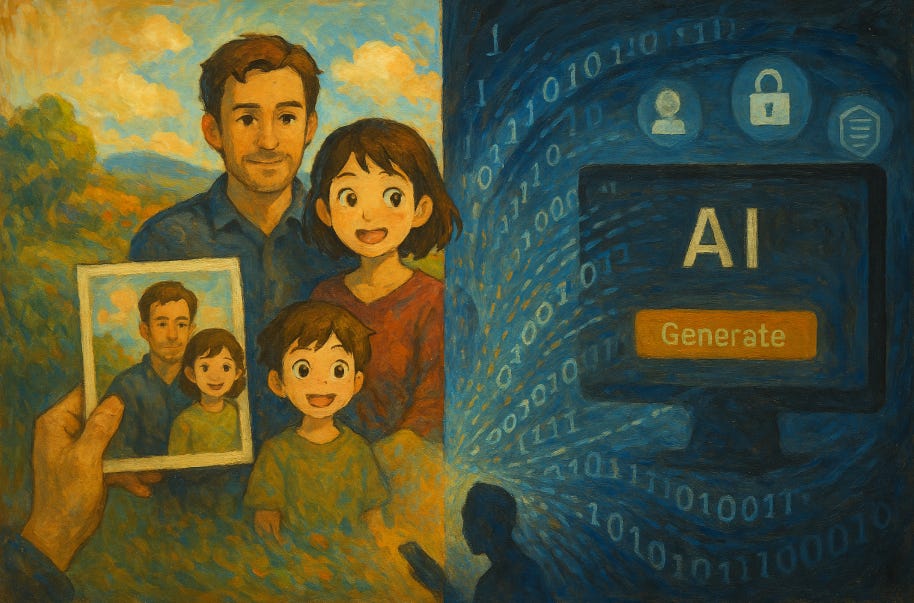
The popularity of the trend was largely driven by individual users rather than by any direct marketing from OpenAI, the company behind ChatGPT. For example, software engineer Grant Slatton posted a tweet showing how he had turned his family photos into anime-style art, which received over 27 million views, greatly increasing the trend's visibility.
Several key factors contributed to the trend becoming widespread:
Immediate Appeal: Attractive and emotionally engaging visuals.
Ease of Use: Simple instructions made participation easy.
Shareability: Personalised outputs encouraged social sharing.
Cultural Popularity: The anime style resonated with a broad audience.
Influential Participation: Public figures, including OpenAI's CEO, joined in, further raising the profile of the trend.
Data Collection Behind the Scenes
While many users enjoyed creating and sharing their images, the process quietly involved substantial data collection. According to OpenAI’s privacy policy:
“We may use content submitted to ChatGPT, DALL·E, and other consumer services to improve model performance.”
Although OpenAI offered privacy settings allowing users to opt out, the ease of participation likely meant that most users remained unaware and used default settings. Consequently, many images uploaded by users may now be part of OpenAI’s training datasets.
Research into this phenomenon highlights an important distinction in privacy law. Images publicly scraped from websites face strict regulations, such as the EU's GDPR, which demands clear justification for collection under "legitimate interest." In contrast, voluntarily uploaded content often falls under "consent," giving companies greater flexibility in data use.
Beyond Simple Good or Bad
Some critics of the "Ghibli Effect" suggested that it may have been a strategic move by OpenAI to collect large volumes of user data under the guise of a lighthearted, viral trend. The idea is that by encouraging people to upload personal photos without fully understanding how those images might be used, OpenAI was able to gather diverse visual data that could be used to improve its AI systems. This critique posits that the viral appeal may have served as a convenient vehicle for data acquisition on a massive scale.
Analysing the "Ghibli Effect" reveals a nuanced picture rather than a straightforward case of good or bad:
Arguments against deliberate orchestration:
Originated naturally through user experimentation.
OpenAI did not initially promote the specific anime style.
Factors suggesting strategic advantage:
OpenAI actively embraced the trend after its popularity grew.
OpenAI’s CEO publicly participated, raising visibility.
Data settings defaulted to broad collection, potentially gathering extensive user-generated images.
A balanced interpretation suggests OpenAI didn't explicitly start the trend to collect user data but clearly benefited from both promotional exposure and the increased availability of diverse data.
An Emerging AI Development Pattern
The "Ghibli Effect" illustrates a broader pattern AI development:
Companies launch appealing generative AI tools.
Users willingly contribute personal content.
Collected data helps refine AI systems.
Improved AI systems lead to even more engaging tools, repeating the cycle.
This approach contrasts with traditional methods of data collection, relying more heavily on voluntary user participation.
Intellectual Property Considerations
Although this article primarily focuses on data privacy and user interaction with OpenAI’s technology, it’s worth noting the related debate around intellectual property rights. Using Studio Ghibli’s recognisable style has raised questions about artistic ownership, copyright and the permissible extent of creative inspiration in generative AI.
Digital Literacy and User Awareness
The "Ghibli Effect" underscores the importance of digital literacy in understanding AI technology and privacy implications. Users often overlooked critical points:
Uploaded images could be retained indefinitely.
Personal photos could be used to train AI systems.
Family, intimate, or private photos might become part of permanent data sets.
Privacy opt-out options were easily overlooked.
One commentator summarised the issue clearly: "Once you submit your photo, you've lost control of it."
Key Questions
The popularity of the "Ghibli Effect" raises important questions:
What does genuine informed consent mean when engaging with viral AI tools?
How should companies balance innovation and transparency in data use?
When might enjoyable features obscure significant privacy concerns?
How should society evaluate trade-offs between exciting new tools and data privacy?
These questions require careful thought from users, AI developers, and policymakers alike.
Encouraging Responsible AI Participation
A valuable lesson from the "Ghibli Effect" may be the importance of developing stronger digital literacy. This new form of awareness helps users enjoy AI-generated content while understanding the data implications.
When engaging with future AI tools, users should ask themselves:
What happens to my data after creating my content?
Is there an easy-to-find privacy opt-out?
What data am I unintentionally providing?
By becoming more informed, users can enjoy innovative AI experiences while protecting their personal data.
In a world increasingly integrated with AI, maintaining a balanced understanding of technology’s appeal and its privacy implications will be crucial for making informed decisions about digital participation.