


Nobody tells you that agency hurts.
We talk about it like it’s empowerment, like it’s freedom, like it’s the thing everyone should want. We frame it as liberation from constraint, as the ability to choose your path, to author your life, to be the protagonist of your own story. And all of that is true in some technical sense, the way it’s technically true that climbing a mountain gives you a better view.
The view comes with vertigo. That being the one who decides means being the one who’s wrong. That sovereignty over your own direction means you can’t blame the current when you drift, can’t point to the map when you’re lost, can’t cite the authorities when your choices lead somewhere you didn’t intend.
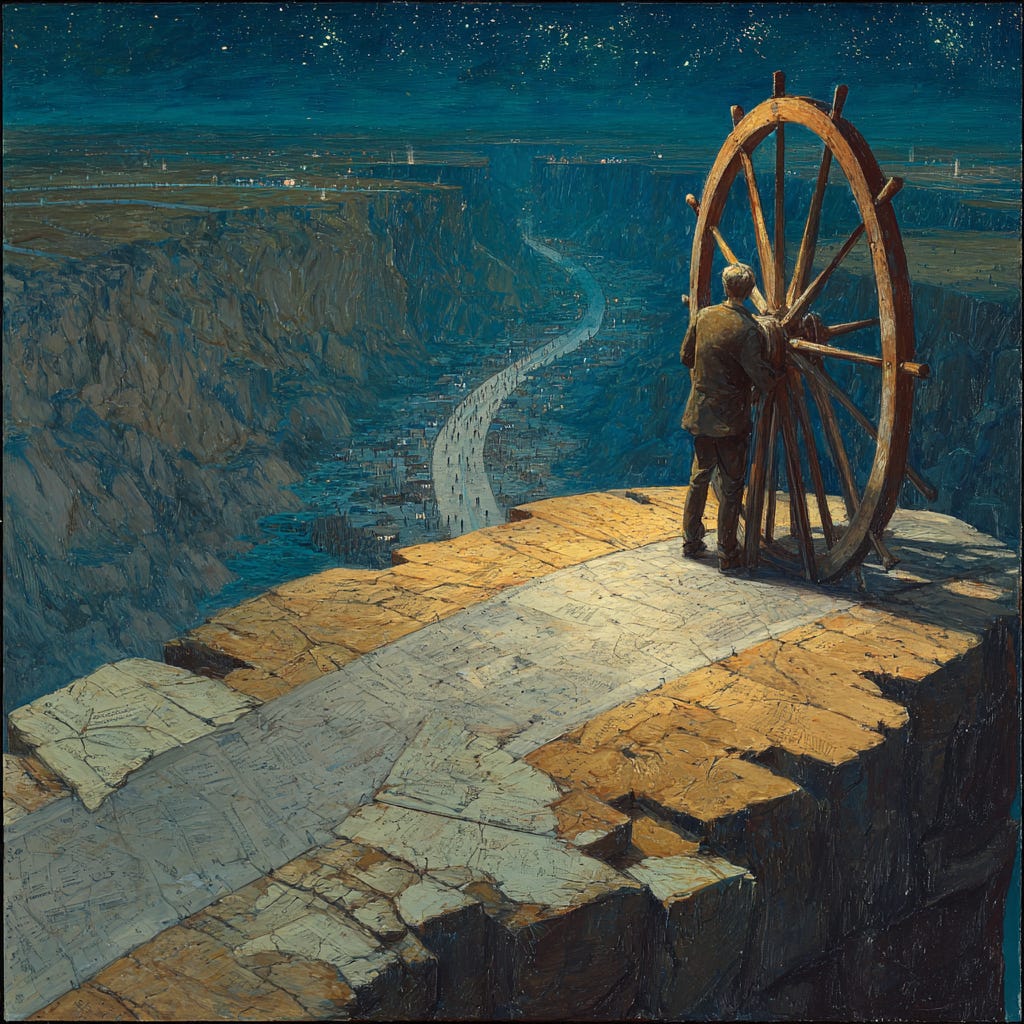
Agency means sitting in the captain’s chair. It means being awake when everyone else is sleeping. It means seeing the console full of decisions that need making, none of them with obvious answers, all of them yours to own.
Most people, most of the time, are passengers.
There’s a particular comfort in following. Not the comfort of ease, though there’s that too, but the deeper comfort of not being responsible. Of having someone else’s judgement to appeal to. Of being able to say “they decided” or “that’s what you’re supposed to do” or “everyone does it this way” and feel the weight lift off your shoulders.
I see this in the structures we build. The pathways we create that make certain choices obvious and others unthinkable. The way we organise careers into sequences, education into grades, lives into stages. All of it designed, whether intentionally or not, to absorb the terrible burden of direction from the individual and distribute it across systems we can follow without thinking too hard about whether they’re pointing the right way.
Look at how we talk about success. It’s always comparative. You’re successful relative to benchmarks someone else set. Good job, good university, good neighbourhood, good retirement plan. The goalposts are already there. Your task is to reach them. The question of whether these are the goals worth pursuing never quite comes up, or if it does, there are thought leaders and frameworks and conventional wisdom ready to answer it for you.
This isn’t conspiracy. It’s coordination. A society can’t function if everyone’s constantly questioning every baseline assumption. We need shared understandings, common directions, agreed-upon markers of progress. The infrastructure of meaning has to be somewhat stable or nothing would get built.
But there’s a cost to this that we pretend isn’t there. The cost is that following the path means never having to ask if it’s your path. It means never having to sit with the nauseating question of what you actually want when there’s no rubric to score it against, no benchmark to compare it to, no framework to evaluate it by.
Agency is the act of asking that question and sitting with it until you find an answer that’s actually yours. Not an answer that sounds good in your field. Not an answer that your parents would approve of. Not an answer that fits the narrative arc people expect. An answer that you’d defend even if no one understood it. An answer you’d choose again if you had to start over.
Once you’ve asked the question sincerely, once you’ve admitted that the emperor’s goals might not fit you, once you’ve looked at the path everyone’s on and thought “but what if that’s not where I want to go,” you’ve stepped outside the shared reality that makes social life predictable.
You’re alone with your choices. And being alone with your choices means being alone with your consequences.
The way I learned this was slow, then sudden. For years I made what looked like good decisions. Obvious positions, respected paths, work that others valued. I could explain every choice with reference to some external logic. This is what serious people do. This is where the best opportunities are. This is how you build a career that matters.
I was intelligent about it. Strategic, even. But I wasn’t agentic. I was optimising for variables someone else had defined as important, playing a game whose rules I’d internalised so completely I’d forgotten they were rules rather than reality.
The moment it broke was small. Someone asked me what I actually wanted, not what I should want or what would be impressive to want, and I didn’t have an answer. I had sophisticated explanations for why my choices made sense. I could cite insights, quote mentors, reference best practices. What I didn’t have was the felt sense of wanting something because I had decided it mattered.
That’s when you realise you’ve been a passenger in your own life. Everything you’ve done makes sense according to the map, but you’re not sure the map was ever yours.
Becoming agentic after that is not about making different choices. It’s about developing the capacity to sit with the full weight of being the one who chooses. About learning to feel the difference between “this is what I should do” and “this is what I’ve decided to do.” About building the tolerance for the discomfort of not knowing if you’re right.
Agency requires you to know what you want when there’s no consensus about what wanting that thing means. It requires you to pursue it when people whose opinions you respect think you’re making a mistake. It requires you to persist when the feedback says you’re wrong, to change direction when your own judgement says the goal was misguided, to own the whole messy process of trying to build a life that fits you rather than a template.
It requires, most of all, that you develop judgement. Not intelligence, which is abundant and increasingly algorithmic, but judgement. The ability to look at situations without clear answers and make choices you can defend to yourself later. The capacity to distinguish between what you think because you’ve thought it through and what you think because it’s in the water.
Agency is hard because intelligence gets you far with borrowed goals. Judgement only matters when the goals are yours.
You can see the difference. You can watch someone who’s intelligent but not agentic and someone who has real sovereignty over their own direction and they move differently through the world. The first person is better at playing the games that are already established. They’re faster, more efficient, more successful by conventional measures. They know how to recognise the pattern and execute the known solution.
The second person is slower, messier, harder to predict. They make choices that don’t quite make sense from outside. They pursue things that don’t have established value. They’re willing to fail at things they decided mattered more than they’re willing to succeed at things they’re supposed to care about.
The first person can tell you why every choice they made was correct according to the criteria that govern their field. The second person can tell you why they made the choice even when the criteria said otherwise. The first person has a resume. The second person has a direction.
I’m not romanticising this. The second person often looks like they’re thrashing. They sometimes are thrashing. They make mistakes that could have been avoided by following established wisdom. They waste time on paths that were never going to work.
But they’re awake in their own lives. They’re not optimising for someone else’s scoring function. They’re building the capacity to choose and to own their choices and to integrate what they learn into something coherent that’s genuinely theirs.
Authenticity means purposeful integration. Not purity of origin, not independence from influence, not some romantic notion of the untouched self. We mean purposeful integration. We mean taking what comes from outside, what you encounter, what you’re taught, what you’re given, and doing the hard work of deciding what to keep and what to discard and how to weave it into something that makes sense as a life you’re authoring rather than a script you’re performing.
Agency compounds in a way intelligence doesn’t. Intelligence makes you better at solving known problems. Agency makes you better at deciding which problems are yours to solve. Intelligence helps you optimise paths. Agency helps you choose destinations.
Over time, over years, the person who’s developed agency ends up somewhere genuinely different. Not necessarily somewhere better by external metrics, though often yes. Somewhere that actually fits them. Somewhere they chose rather than somewhere they ended up.
And you can’t teach this. Not directly. You can’t hand someone a framework for being agentic. The frameworks are what you’re learning to see past, to use when useful and discard when they constrain, to engage with rather than be captured by.
What you can do is create the conditions where agency becomes possible. Where there’s space to not know. Where there’s tolerance for trying something that might not work. Where there’s permission to pursue goals that don’t show up on anyone’s standard list of achievements. Where there’s models of people staying in the captain’s chair through uncertainty rather than reaching for the autopilot when things get complex.
But ultimately the work is yours. The work of sitting with the question of what you actually want. The work of developing the judgement to pursue it. The work of owning your choices even when they don’t lead where you thought. The work of being awake to your own becoming.
Nobody tells you that this work never ends. That agency isn’t a state you achieve, it’s a practice you maintain. That you have to choose it again and again, in moment after moment, with every decision that matters.
Because the pull toward following is always there. The comfort of letting someone else decide. The relief of having a benchmark to aim for that everyone agrees is worthwhile. The ease of choosing what others are choosing and calling it preference.
Staying agentic means resisting that pull. Not all the time, not in every domain, but in the places that matter to you. It means keeping the question alive, what do I actually want and why, even when the socially acceptable answers are readily available. It means protecting the weird inefficient messy parts of your life that don’t optimise for anything except being genuinely yours.
It means, most of all, staying in the captain’s chair even when you don’t know where you’re going. Even when the passengers are comfortable and you’re not. Even when following the prescribed route would get you somewhere impressive while charting your own course might lead nowhere anyone recognises.
The weight of the captain’s chair is the weight of being responsible for your own direction. Of not being able to appeal to what you were supposed to do, what everyone does, what the experts recommend. Of having to own your choices and their consequences and the whole uncertain process of trying to build a life that’s actually yours.
Not everyone picks up that weight, and that’s legitimate. There are lives worth living on established paths. Work that matters within structures others built. Satisfaction in mastering games you didn’t invent. The question isn’t whether one choice is superior, but whether the choice you’re making is actually yours.
Some people choose the established route after genuine consideration. They’ve looked at the alternatives, felt the weight, and decided that what others have built aligns with what they want. That’s agency too. That’s ownership.
The difference is whether you’ve sat with the question. Whether you could articulate why you’re where you are in terms that don’t reference what you’re supposed to do. Whether the life you’re living fits not just by social metrics but by ones you’d defend even in private.
The ones who do pick it up, who stay in the chair, who keep choosing their direction even when it’s hard, they don’t always end up where they planned. But they end up somewhere they chose. Somewhere they can own. Somewhere that fits.
That difference matters if it matters to you. The question isn’t which path is right, but whether you’re on the one you’d choose if you had to choose again.
Agency costs you the comfort of following. It gives you authorship of your own direction. Not everyone needs that trade. But if you’ve felt the difference, if you’ve really sat in the captain’s chair and kept it through the vertigo and the uncertainty and the weight, going back becomes impossible.
Not because passengers are wrong. But because you’ve learned what it feels like to steer.
I’ve been in the Captains Chair for so long and to most outside me my path looks so unpredictable and it is… I do not match the criteria of a ‘successful’ life but this path I am following right now is exactly the one I want to be on. I wouldn’t give it up for anything.
It would be nice to have a cushion though!