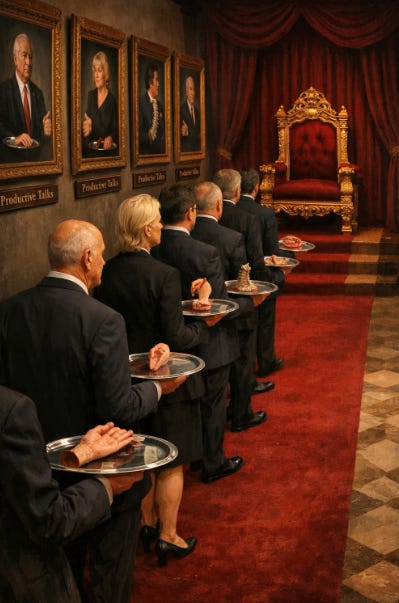
The Spine Doctors

There’s a script running. You’ve seen it enough times now that pretending otherwise is its own kind of participation.
The obscene opening demand. The public theatre. The whiplash between flattery and contempt. The ceremony at the end where everyone pretends something was achieved.
We keep calling it “negotiation.” We keep sending professionals to “engage” with it. We keep writing analysis about “dealmaking styles” as if we’re observing a cultural difference rather than a predation pattern.
It isn’t negotiation. It’s a coercion protocol. And the most unforgivable part isn’t the protocol itself. It’s how many serious people keep feeding it while calling the feeding “statecraft.”
The script
Move one: the anchor that isn’t an anchor.
The opening demand arrives so lopsided it reads like parody. This is deliberate. Negotiation research confirms that extreme first offers can pull outcomes toward the offerer, but they also provoke offence and increase the risk of impasse because people correctly read them as bad faith.
That’s not a bug. That’s the feature.
The demand isn’t meant to be accepted. It’s meant to reset the frame. After the shock, anything less insane starts to feel “reasonable.” The Overton Window gets brass knuckles. The conversation now happens inside a building the bully constructed while you were still reading the invitation.
Move two: the spectacle.
Everything goes public. Announcements, threats, performative outrage, the photo op that implies submission before anyone has agreed to anything.
This forces a trap with no clean exit:
Respond quickly and you look reactive. Respond slowly and you look weak. Compromise and you’ve admitted guilt. Stay silent and the story writes itself without you.
The theatre isn’t incidental. The theatre is the leverage. The cameras are not documenting the negotiation. The cameras are the negotiation.
Move three: the whiplash.
Today you’re a “friend.” Tomorrow you’re a “parasite.” Next week you’re invited to a “historic summit.” The goal is to keep everyone so off balance they start negotiating against their own anxiety rather than toward their own interests.
This is the old madman posture from coercive diplomacy: make the other side believe you might do anything, so they give you something just to reduce the uncertainty. The history of that approach is not a fairy tale. It’s a warning label that keeps getting ignored by people who should know better.
Move four: the status game.
Everything gets personal. Flattery tests. Loyalty tests. Humiliation tests. “Respect” becomes currency you pay upfront, often in public, just to be allowed into the room.
Notice the shift. You are no longer negotiating terms. You are negotiating status. And status is a game the bully-showman knows how to rig, because the bully-showman built the arena, hired the referees, and sold the tickets.
Move five: the win that isn’t a win.
The endgame is never a durable agreement. It’s a headline. A photo. A renamed framework. A ceremonial signature. Anything that can be marketed as conquest.
If the substance is thin, the packaging gets thicker. If the substance is messy, the story gets louder. The deal is a prop. The victory narrative is the product. Everyone goes home. Nothing is solved. The prop gets photographed.
Why the professionals keep losing
This method keeps working because too many people respond to it in ways that reward it.
They confuse calm with success.
They pay a concession to buy a quiet week. They call this “diplomacy.” It isn’t. It’s protection money. The quiet week costs more than the concession. It costs the precedent. It costs the next negotiation. It costs everyone watching who now knows what the price of peace looks like.
They treat access like achievement.
They mistake “we got the meeting” for “we got the outcome.” They brief the press about the handshake. They analyse the body language. They interpret the compliment. Congratulations. You got an audience with the problem. The problem enjoyed the attention. The problem is still the problem.
They negotiate as individuals when the only safe posture is collective.
A bully loves isolated targets. When leaders peel off to make their own little side arrangements, they don’t look pragmatic. They look edible. The special relationship is not special. It is a queue. Everyone in the queue believes they are the exception. No one in the queue is the exception.
They argue inside the bully’s frame.
If the opening demand implies you’ve been cheating, and you respond by debating the exact amount you supposedly owe, you’ve already lost. You accepted the premise. You are now haggling over the invoice for a debt that doesn’t exist. The frame was the attack. The frame won.
They believe appeasement is statesmanship.
It isn’t. It’s cowardice with better stationery.
When a leader gives in to keep things stable, they are not stabilising anything. They are training the tactic. They are teaching: make a threat, get a prize. That is how you breed more threats. That is how you build a market for coercion. That is how you make the next negotiation worse for everyone who comes after you.
And yes. This deserves contempt. Not because contempt is satisfying. Because contempt is accurate.
The correct responses
Protect your alternative like your life depends on it.
Your BATNA, your best alternative to a negotiated agreement, is oxygen. Without it, you are negotiating while holding your breath. The bully-showman will smell it and squeeze.
Reduce dependency. Diversify supply chains, energy sources, security arrangements, trade relationships. Pre-coordinate fallback measures with allies. Make your “no deal” plan real, funded, and ready. If you cannot walk away, you cannot negotiate. You can only surrender in instalments.
Refuse to negotiate on the stage.
The spectacle is home-field advantage for the coercion protocol. Drag the conversation off the stage and into paperwork. Written proposals. Technical teams. Defined timelines. Documented commitments.
Bureaucracy is not weakness here. Bureaucracy is armour. Process is protection. The longer the timeline, the less power the tantrum has. The more paper involved, the harder it becomes to rewrite history with a press conference.
Force interests and objective criteria.
Separate people from the problem. Focus on interests, not positions. Generate options. Insist on objective criteria. This is the core of principled negotiation, and it’s not a classroom exercise.
You don’t separate people from the problem to be polite. You do it to deny emotional leverage. Objective criteria aren’t academic. They’re a trapdoor. If the bully refuses them, you’ve publicly exposed bad faith without getting dragged into the mud. If the bully accepts them, you’ve changed the game.
Make consequences automatic.
The bully-showman thrives on improvisation and panic. So stop improvising. Pre-commit to responses. If X threat is issued publicly, Y countermeasure triggers. If Z agreement is violated, A penalty applies.
No drama. No rage. Just physics.
When consequences are predictable, “strategic uncertainty” collapses into ordinary bluffing. The madman posture only works when people believe the madness. Automated responses make the madness irrelevant.
Never reward threats with concessions.
This is the rule. It is astonishing how many leaders forget it the moment a camera appears.
If a threat produces a payoff, you have created a business model: Threat, concession, repeat. The business will grow. The threats will multiply. The concessions will compound.
Instead: Threat, cost, repeat. Now repeat becomes expensive. Now the model stops working. Now the bully has to find a different game.
Coordinate relentlessly.
If you are facing a coercion protocol, you need shared messaging, shared red lines, shared countermeasures, and no solo special-relationship side deals.
The bully’s dream is a line of leaders individually auditioning for mercy. Do not give them the audition. Do not believe you are the exception. Do not imagine your relationship is different. The relationship is a queue. You are in it. Everyone is in it.
Control the story.
The endgame is propaganda. Treat narrative as part of security.
Do not sell crumbs as feasts. Do not call a retreat a breakthrough. Do not pretend a cosmetic rename is a structural fix. That’s not optimism. It’s self-humiliation.
Tell your public what was demanded, why it was unacceptable, what you offered instead, what your alternative plan is, what happens next. The bully’s leverage weakens dramatically when the audience understands the con. The con depends on confusion. Clarity is a weapon.
The part nobody wants to hear
There is plenty to criticise in the coercion protocol itself. But the ongoing scandal is the adult professionals who keep wandering into it like moths into a bug zapper, then acting surprised at the sizzling sound.
If you reward extortion with “compromise,” you are not pragmatic. You are useful. To the extortionist.
If you treat bad-faith theatrics as a serious opening position, you are not being diplomatic. You are being played.
If you believe the solution is to flatter harder, concede faster, or “build rapport,” you are not showing sophistication. You are showing a fatal misunderstanding of what is happening in front of you.
This is not a negotiation style that deserves respect. It is a coercion style that deserves containment.
Containment is not about matching cruelty. It is about matching discipline. Disciplined process. Disciplined coalitions. Disciplined enforcement. Disciplined refusal to feed the beast.
That is the grown-up move.
Everything else is surrender with nicer adjectives.