
The Singularity Already Happened
Just Not the One They're Describing.

Sam Altman says we are past the event horizon and the takeoff has started. Dario Amodei expects a country of geniuses in a datacentre by 2026 or 2027. Demis Hassabis describes us as standing in the foothills of the singularity. Yann LeCun calls the whole concept nonsense and proposes a different vocabulary. Yoshua Bengio says the relevant thresholds may already have arrived and we are not ready.
Read together, in roughly the same eighteen-month window, these statements look like a record of disagreement. They are also a record of agreement, of a kind that nobody making them needs to name for it to operate.
The agreement is about who speaks. There are five men in the room. Each holds a position at a major laboratory, foundation or research institute. Each brings a vocabulary for roughly the same territory. The question they have been asked to answer is whether they have the timeline right. The question of who else might have answered, in what other registers, on what other timescales, is not on the agenda.
What the five share, without needing to declare it, is roughly this. The future of humanity is a topic over which their interpretive authority is settled enough that nobody contests it. The appropriate vocabulary is some variant of threshold, takeoff, event horizon, capability curve, alignment, control. The relevant timescale runs somewhere between two and ten years. Definitions matter, because definitions structure investment, hiring, regulation and the felt urgency of policy. Whether the singularity is real or not, the singularity discourse is the place where the real future is being decided.
This last point is the one worth dwelling on.
When Hassabis says we may be in the foothills of the singularity, the metaphor does several things at once. It locates the speaker on rising ground with the listener as fellow traveller, looking up the slope toward a mountain somewhere ahead. The image is generous, almost pastoral. It makes the future feel walkable.
The image works, though, only if you accept the mountain. Foothills exist as foothills relative to a summit. Take the summit away and they become something else. A hallway, for instance. A corridor where particular vocabularies have crowded in and other vocabularies have been quietly displaced. From the foothills you can look up the mountain. From the hallway you can see who else might be in the building, and notice that they are not in this room.
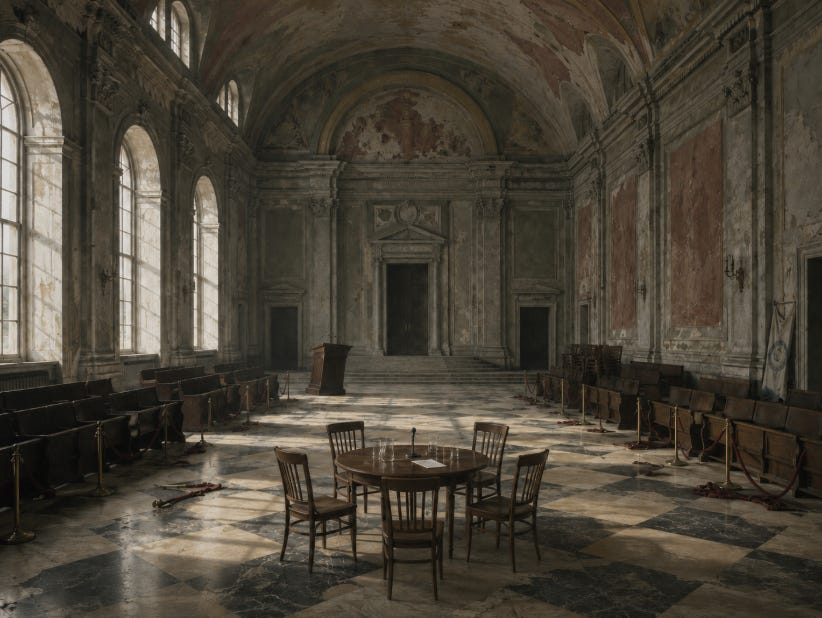
Consider what is not at the table. There is no chair held by anyone whose primary work is care. No chair for a teacher of small children, for a worker whose role is being reshaped this quarter by deployed systems, or for someone whose elders are dying in a regional hospital where rosters depend on a predictive scheduling tool. No chair for the moderators in Manila, the data labellers in Nairobi, the call-centre staff in Cape Town. No chair for the ecological substrate, the water and copper and electricity that the conversation requires in order to exist. No chair for anyone whose timescale is the next half-century rather than the next presidential cycle.
The conversation has been organised so that those chairs were never set. The five men at the table are doing the thinking that the configuration of public life has assigned to them, and they are doing it well. The problem is the configuration.
Each of the five positions deserves respect on its own terms. Hassabis is careful about what would count as genuine intelligence. Amodei is honest about danger, Altman concrete about deployment. LeCun applies proper scepticism to whether the dominant technical paradigm can reach what it claims, and Bengio brings courage to the catastrophic-risk question in a discourse that prefers to soften it. There is no fool at the table.
The shape of the conversation, however, makes everything any of them say a contribution to a kind of closure. The closure belongs to the configuration of the room, not to the speakers. It is what makes their being at the table possible.
Consider how this came about. The institutions that used to broker public futures, parliaments, public broadcasters, universities, churches, trade unions, professional associations, have been hollowed out or have hollowed themselves out, in different ways and on different schedules across the rich democracies. Some of this is the work of decades of policy. Some of it is more recent, the migration of the public square onto platforms owned by a handful of firms. By the time large language models arrived in 2022, there was no longer a serious public forum capable of brokering a conversation about what they might do. The space was already empty. The frontier labs and their most prominent critics moved in because there was space to move into.
The disappearance of serious public reasoning about technological futures preceded the singularity discourse and made it possible. The AI conversation colonised an empty room. The room was empty because the institutional fabric capable of holding such a conversation had already worn through.
The conversation about institutional alignment, the question of whether AI systems will be aligned with human values, is being conducted by institutions whose own alignment with human flourishing is open to serious doubt. The five-person table is not aligned with the public it claims to speak about. The five speakers do not pretend otherwise. They are not pretending to be a parliament. They are doing what serious private actors do in the absence of a serious public broker. The misalignment lives in the shape of the room rather than in the character of the speakers.
If you wanted to give the present its proper name, you might call it the singularity of authorised futures. It is the moment in which only certain people, speaking in certain registers, on certain timescales, are heard when the future of humanity is being discussed. The event horizon Altman describes may or may not be ahead of us. The one I am describing is behind us. It was crossed somewhere in the long erosion of the publics that used to convene this kind of speech, in a way that produced no dramatic moment, only a quiet narrowing of what counted as serious.
This narrowing has consequences for what we can think.
One consequence is that policy gets calibrated to frontier-lab forecasts. When Amodei says powerful AI may arrive by 2027, that statement enters the bloodstream of treasury departments, education ministries, defence procurement budgets and grant-making bodies in a way that no academic forecast, no civil-society document, no slow scholarly consensus can match. The five-person table sets the calendar for institutions that have stopped setting their own.
A second is that education systems chase a target whose definition keeps moving, set by speakers whose interest in the moving is itself part of the dynamic. Schools and universities are asked to prepare students for a world that Hassabis describes as the foothills, that Altman describes as the takeoff, that LeCun describes as misdescribed. The bodies that should be the slow brokers of intergenerational knowledge are reduced to matching the velocity of a discourse that generates its own velocity.
The deepest consequence is that the present becomes hard to see. When five voices tell you that the meaningful moment is two to ten years away, the texture of what is happening now becomes background. The deployments now reshaping clinics and call centres and classrooms become routine matters, ordinary infrastructure, beneath the threshold of the threshold conversation. The most consequential AI in the world right now is the workflow tool deployed last month in a regional school district, with an implementation plan written by a vendor and adopted by an under-staffed administration that cannot afford to argue with it. The frontier model that may exist in 2028 will arrive into a world this tool has already reshaped. That smaller AI does not appear in any of the five vocabularies, because it is too small to register, and the discourse is calibrated only for the spectacular.
A discourse that cannot see the present cannot, in any meaningful sense, see the future either. It can see futures, which is a different thing. Futures are projections from inside the vocabulary. The future is what arrives whether or not the vocabulary noticed.
There is a temptation here, which I want to resist. The temptation is to say: well, then, we must broaden the conversation. We must bring more voices to the table. We must include the carer, the teacher, the librarian, the rural worker, the climate scientist, the philosopher, the historian. This is the move toward what someone in a workshop will call the holistic frame, and it is the move I do not trust. The room is the problem, not the table. Putting more chairs at a table that has no roof, no walls and no constituency does not make a public out of a press conference.
The institutions that once held such rooms are tired or compromised or gone. The platforms that replaced them were not built for this kind of speech. The labs are not pretending to be such a room, and asking them to pretend would only deepen the closure. The critics are doing useful work but they are not a public.
What remains is something modest: a discipline of attention rather than a programme. The five voices are saying real things. The agreement underneath their disagreement is also real, and more consequential than the disagreement. The empty room in which the whole conversation reverberates is more consequential than either. Noticing the room does not produce a room. It does produce a refusal to mistake the press conference for the public.
The foothills metaphor implies a walk uphill toward a peak. The hallway metaphor implies a walk along a corridor, past doors, perhaps into other rooms. Both are still walks. Neither produces what is missing.
The singularity has already happened. The one that has happened is older and quieter than the one the speakers describe. It is a singularity of voice rather than capability, of who can be heard rather than what can be built. The takeoff began somewhere in the long emptying of the publics, the migration of futures into private hands and the moment when a five-person table came to constitute the operative forum for what comes next.
We may indeed be in the foothills. The mountain may indeed be ahead. The building we stand in is largely empty though, the door has closed, and the men at the table are not the ones who closed it.
‘No chair for anyone whose timescale is the next half-century rather than the next presidential cycle.’ - this line punches way above its weight. Wonderful article.
Also, there are people having the conversations, but the echo chamber is not seeing those other conversations.