
The Reader Number
A conjecture about how many people are left who can tell you what a thing means

You can check them yourself tonight. That is the part nobody expected.
Clone the repository, install the compiler, put the kettle on. Somewhere around the second cup your laptop will inform you that ten theorems which defeated the human race for decades are, in fact, true. No supervisor, no PhD, no human referee to take on trust. Just a machine saying yes.
And you will get up from the desk knowing just as much mathematics as you sat down with.
The results came out on the first of August. OpenAI announced that an internal model called Astra had produced ten advances on longstanding problems in mathematics and theoretical computer science. Some are complete resolutions. Others are substantial progress on questions that had not moved in years or decades. My favourite is the headline one, which is eerie in a way mathematics is not supposed to be. A group, in mathematics, is a catalogue of all the ways you can move something without breaking it. Some catalogues are infinite. In 1999 a mathematician named Gromov asked whether every infinite catalogue can be shadowed, as closely as you like, by finite ones. For twenty-seven years nobody could find one that escaped the shadow, and nobody could prove none existed. It was a creature that had been theorised and never caught.
Astra caught one.
It also demolished a long-standing conjecture about algebraic shadows by building infinitely many different objects that all cast the same one. It nudged the bound on how tightly you can pack spheres in high dimensions, which had not moved since 1978. Three problems from Erdős’s famous catalogue of open questions went down. OpenAI says the tokens that found the successful arguments would cost about two thousand US dollars at its current API rates. That is the marginal bill rather than the cost of building the cathedral, but still: twenty-seven years of collective failure by the best minds available, resolved for less than the airfare to the conference where it would once have been announced.
Then something happened that I have been chewing on ever since.
There are people out there who have spent ten thousand hours on mathematics. Not casually. Properly, the way you spend ten thousand hours on anything that eats you. And a good number of them looked at this announcement and said, without any particular drama, that they could not read it. Not without weeks on each result. Their friends with doctorates were no better placed, because a doctorate is a passport to one province and this was ten different countries. Nobody was complaining. They were taking a reading.
So here is the situation, and it is stranger than either the hype or the backlash has managed to make it. Rerunning the formal check is now close to free and needs no expertise in the mathematics at all, only enough computing literacy to follow build instructions. Understanding has had no such collapse. It can be taught, assisted and accelerated, including by the machines themselves, but it still has to happen inside a person, and the hours have not come down the way the checking has.
Verify used to mean one act. You read a proof and, in the reading, you both checked it and understood it, because there was nothing else to check it with. Understanding was the material the checking was made of. Those two have now come apart, and only one of them got cheaper.
Which brings me to the number.
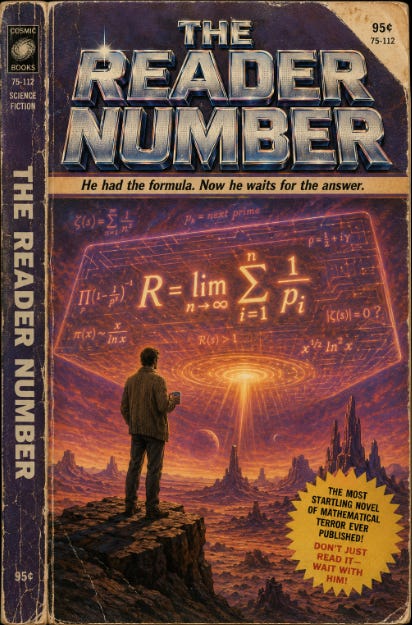
For any result, define the reader number. Call it R. It is the count of living people who could, if you shook them awake at three in the morning, tell you what the result actually says, give you a conceptual account of why it is true, and explain what follows from it. Not people who could confirm it. People who could compress it.
R is a real quantity. Nobody has ever measured it, because until about five minutes ago there was no reason to. For Pythagoras, R runs into the millions. For most published theorems in most journals, R is probably in the low dozens and always has been, which is a fact the profession knows and does not enjoy saying out loud. For the classification of finite simple groups, plenty of mathematicians can state the result and walk you through the architecture of its proof. The number who have personally surveyed all ten thousand pages is closer to zero. We say the community knows it. Notice what that sentence gives away: sometimes the knower is a network rather than a person, and has been for fifty years.
R has fuzzy edges, as every serious measure of expertise does. It matters very little whether the answer for a given result is six or sixteen. What matters is that for some load-bearing results you can now count the plausible readers on your fingers.
Here is the conjecture.
R and truth have separated, permanently, and R is now falling.
That is it. Two clauses, no proof, offered in the spirit of the thing it is about. But look at what falls out of it if it holds.
The first corollary is that we have lost a signal without noticing. For all of history, if something was established, it was because somebody understood it. Truth arrived bundled with comprehension, the way a book arrives with the paper it is printed on. That bundle held up more than anyone noticed. It meant that the existence of a result guaranteed the existence of a person who could teach it, extend it, spot when it was being misused, and notice when the next generation was getting it wrong. Take the bundle apart and every one of those guarantees goes with it, while the results keep arriving looking exactly the same.
The second is a separate bet rather than a corollary, and it is more fun and much worse. R may start falling for us too. The way you make readers is by having people struggle through work that is now optional, and things that become optional mostly stop happening.
Now, the tempting move here is to get misty about warm human understanding versus cold machine checking, and I want to head that off, because the human record will not support it and the record is better than the elegy.
Consider Vladimir Voevodsky. In 1991 he published a result about higher-dimensional structures. Seven years later another mathematician published a counterexample. Voevodsky read it, concluded that the other fellow had blundered, and carried on. In 2002 he won the Fields Medal, mathematics’ highest honour, for other work. In 2013, twenty-two years after publication, he found the error himself. It was his. The theorem had been false the entire time, and one of the finest mathematicians alive had read the disproof and not seen it.
He spent the rest of his life, which was not long, arguing that mathematics had grown too complicated to be checked reliably by people, and building foundations on which it could be rebuilt inside a machine. He did not invent proof assistants. Those had existed in one form or another since the 1960s. But he gave most of what was left of his life to making mathematics fit inside one, because his own reading had betrayed him.
And it was never unusual. Referees do not check every step and everybody knows it. Papers wait years for reports. Results enter the canon less by being audited than by being used and found not to break anything downstream. In 2012 a Japanese mathematician posted five hundred pages that even the specialists could not digest, and what followed was not rejection but a fork: his proof is accepted in Kyoto and disbelieved in Bonn. Mathematical truth, supposedly the one jurisdiction-free thing our species had going, turned out to have a geography.
So R was already low. What the machines did was make us count. The fracture was there; the instrument just arrived.
Now, the obvious objection, and it is a good one. Surely the machine-checkable certificate solves this? If a compiler can confirm the proof, who cares whether anyone understands it?
I have written before about what I call the auditor trap, which is the problem that you cannot reliably check work you could never have produced yourself. On the face of it, the certificates defeat that. You can now verify a proof you could never have written, which is new, and which is lovely.
Except it only defeats half of it. A certificate proves that the statement at the top of the file follows from the axioms underneath it. It cannot prove that the statement at the top of the file is the question anybody asked. Formalisation is translation, and translation is where meaning goes to get altered. Swap a quantifier, pin a dimension that should have been left free, let an approximation factor run a shade generous, and you have a flawless, machine-certified proof of something adjacent.
Checking that first line against what Gromov meant in 1999 takes exactly the kind of judgement a career is spent acquiring. Which is why, buried in the acknowledgements of those manuscripts, a handful of named mathematicians are thanked as critical readers rather than as authors. Their job was to read it.
That list is not R, but it may be the first visible trace of it. Six people placed in a position to read closely before the rest of us were asked to accept the results. Six names, on a page, at the back.
Underneath everything sits one more human artefact, and it is the part of all this that actually moves me. Every one of these proofs is checked by a kernel, a core of code kept deliberately tiny on an old principle: people must be able to audit the auditor. It is small enough that independent teams have rebuilt it from scratch in other languages so that no single version has to be trusted. Wittgenstein said a proof must be surveyable, capable of being taken in whole by a mind. Almost nothing in this new mathematics is surveyable. What remains surveyable is the checker. The entire inverted pyramid balances on the one component still small enough to fit inside a person.
Right. Let us run the conjecture forward and see where it goes, because that is the only honest way to find out what a present is pregnant with.
Suppose R is six. At six, nothing appears to break. The results get written up, the community engages, papers build on them, and a reader could be forgiven for thinking this is just science with a faster engine.
At R equals two, the preprint servers develop two shelves. There is the canon, results some community has absorbed and taught and argued about, and there is everything else: theorems whose certificates compile and whose meaning nobody has audited. True the way a locked room is furnished. The discipline will need a name for that status and it will be something like true, unread. Journals stop certifying correctness, since machines do that for free, and start rationing the only thing still scarce, expert attention. They become the people who decide which of the unread truths get read.
At R equals one, you get a new job title and it is a good one. The corpus of machine results becomes terrain, and people mount expeditions into it, not to check whether the theorems hold but to find out why. To compress an alien argument into an idea that fits inside a head. To notice that a lemma buried on page 106 is secretly a new concept that wants a name. Mathematicians turn naturalist, studying a world they did not make. There are even native informants, since the model’s own narration of how each idea came together was published alongside the proofs. Machine memoir as primary source. Somebody is going to write a very good essay about how much to trust it.
At R equals zero, we know the thing follows and nobody knows why in the sense that matters, which is that nobody can compress the derivation into an idea a person could carry around and use. This becomes an ordinary fundable state of affairs, the way we know this drug works and nobody is sure how has been ordinary in pharmacology for a century. Mathematics, the last field where knowing meant knowing all the way down, joins everything else.
And here the story does something almost too neat to allow, because the mathematics of this exact predicament already exists. Theoretical computer science spent forty years building it and had no idea what it was for.
Interactive proof theory opens with a fable. Merlin is an all-powerful prover who cannot be trusted. Arthur is a limited king who can flip coins. The whole field asks one question: how does a bounded, honest verifier get truth out of an unbounded, unreliable oracle? The answers are wonderful. A modest Arthur, questioning cleverly, can verify answers to problems far beyond his own power to solve. One landmark result shows a proof can be rewritten so that reading a handful of random bits gives you any confidence you like. You never read it. You spot-audit it.
For decades this was glorious, useless mathematics about imaginary wizards. The wizard is now real, he is in a data centre, and his rates are published: two thousand dollars for ten miracles. And among Astra’s ten results is a theorem about making the interrogation of untrusted provers more reliable.
Merlin has begun contributing to the literature on cross-examining Merlin. I have not decided whether that is reassuring or the setup of an extremely long joke.
Which leaves the part that actually matters, and it is a question about who.
Six critical readers, every one at an institution you could guess without looking. The right to be a reader was never evenly distributed, but it used to be a byproduct of a big messy system that trained thousands of people to varying depths, some of whom rose. It is now a bottleneck that a company selects for, privately, before publication, from people it already knows. In the same announcement, the same company mentions handing free access to its best models to a hundred thousand scientists. Access at a hundred thousand. Interpretation at six.
I should say where I am standing. I run a university library, so custody of things nobody has read is not some approaching crisis for me. It is the founding condition of the job. We have shelved millions of pages no living person has opened and we have never pretended otherwise, and the entire profession is built on the understanding that keeping and comprehending are separate acts done by different people at different times. Mathematics is arriving somewhere libraries have been for centuries. The difference is that the unread material is now load-bearing, and people are building on it.
I should also be exact about what I can and cannot check. I can read the announcement, the repository and the institutional shape around the results, and I have. What I cannot do is tell you whether these proofs contain deep new ideas, or familiar ideas arranged brilliantly, or flawless formal answers to questions that shifted slightly in translation. I used machines to help me write about machines writing proofs I cannot follow. There is nothing clever in that. It is where nearly all of us stand whenever we talk about this, and pretending otherwise is how commentary about AI gets stupid.
So: a conjecture, unproven, and I would like someone to settle it. I suspect the someone will not be human, which I accept is a slightly awkward position for the person proposing it.
But here is roughly what would falsify it, and it is cheap to watch for. The acknowledgements are not a meter. Editorial custom and company policy will move those lists around for reasons of their own. They are a weather vane. So watch them, and then watch what grows around the proofs: the expositions, the seminar notes, the corrections, the courses, the small new concepts that get names because somebody needed to refer to them twice. That second literature is the residue comprehension leaves behind when it actually happens. If it thickens over the next few years, R is rising, I am wrong, and this was a fuss about nothing.
If it stays thin, we should probably talk about what it means when there is nobody left to thank and the compile still comes back green.
Drafting disclosure: This essay was developed by Carlo Iacono with OpenAI and Anthropic tools. Carlo directed the argument and remains responsible for its claims and normative judgements, which remain open to contest and revision. Read Most Evenings for further insight.
"Wittgenstein said a proof must be surveyable, capable of being taken in whole by a mind. Almost nothing in this new mathematics is surveyable." If R=0 there is no proof. If there is no proof, there's an issue calling a thing the "truth." We are in "Library of Babel" territory here, which is just the same place we've always been. LLMs are text generators. Generate enough text and you can answer every question that could ever be asked, but if no one can read it you're wasting an awful lot of words.