
The Last Castle
AI's Victory Could Reveal We Were Defending the Wrong Thing All Along?

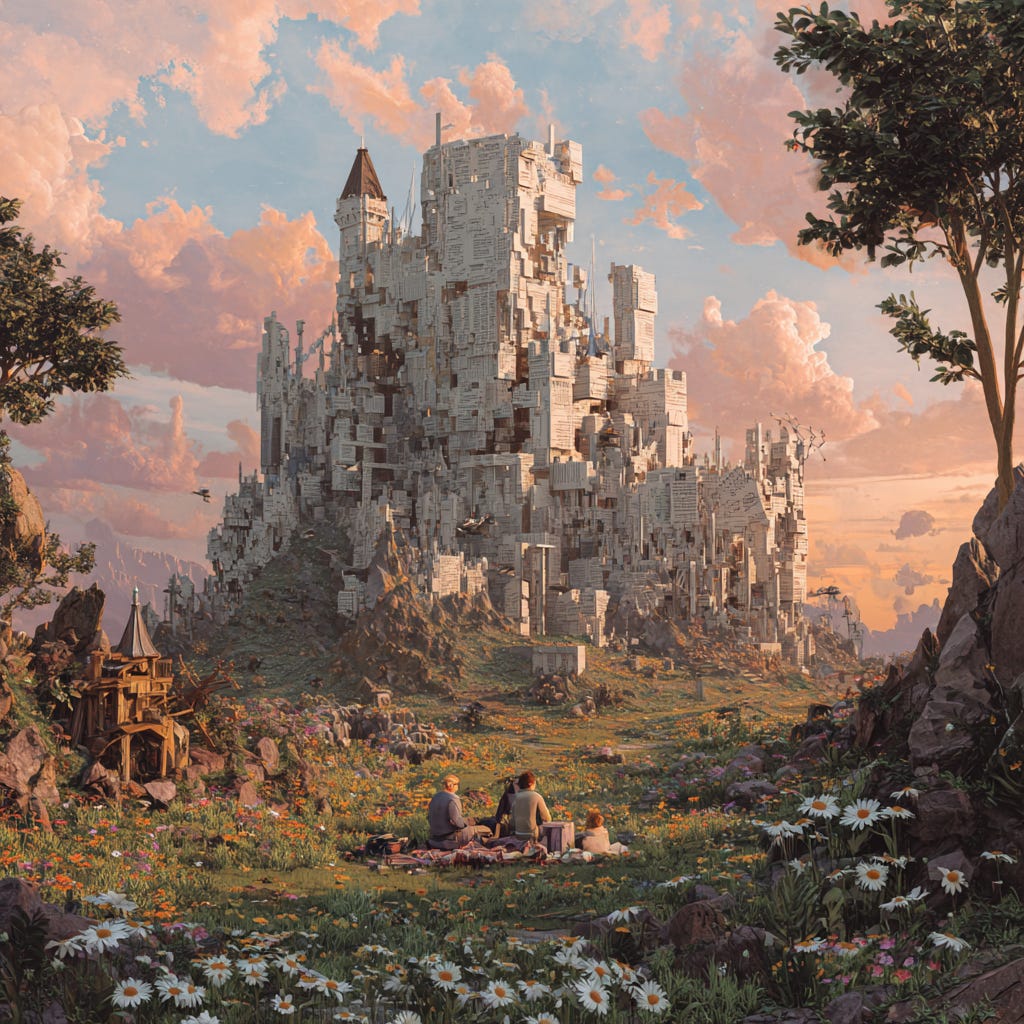
The last castle has already fallen.
We are walking its shattered halls, polishing the stones as if tidiness could reverse the siege. Our rituals of reassurance have become elaborate. We say there must be something still uniquely ours because the alternative is to imagine a future where our cleverness is no longer the centre of gravity. Yet the ground keeps giving way under the same misplaced defences. Context was not a sanctum. It was a buffer size. Creativity was not a visitation. It was recombination at scale. Judgement, in many of the places we swore it lived, turns out to be a habit of applying rules with dramatic inconsistency. This retreat with unnerving clarity, charting how transformers turned context into engineering, how generative models industrialised novelty and how simulated empathy can outperform the queue of tired experts we keep waiting on hold.
We tell ourselves the story of human uniqueness like a bedtime prayer. We are the animal that understands. We are the creature that feels. We are the author of meaning. Then the machines arrive with more memory than our institutions, more patience than our professions, and an ability to synthesise that makes much of our work look like the slow rearrangement of furniture. We retreat to consciousness and call it the final moat. Perhaps it is. The trouble is that markets do not pay for qualia. They pay for results. A system that can pass for understanding in most practical situations is enough to reprice our worth, even if it experiences nothing while doing so.
History should make us modest. The artisans who smashed looms were not fools. They were accurate forecasters of their own diminished bargaining power. The scribes did not vanish in a puff of dust when presses arrived. They moved sideways into new roles inside a much larger information economy. The smithy did not disappear so much as change costume and become the garage. Those transitions did not spare everyone. Aggregates recover. Individuals suffer. The story we prefer to tell is tidy. The actual path was generational and violent and slow.
What makes the present rupture stranger is not that tasks are being automated. That is an old trick. It is that the rungs we used to climb are melting away beneath our feet. The legal apprentice once learned by reading mountains of documents. The junior developer learned by slogging through bugs. The analyst learned by cleaning data until patterns flashed in the mind like weather. Now the entry work evaporates. A machine does it in minutes and does not complain. We congratulate ourselves on efficiency and then discover we have created an experience cliff. We are asking people to supervise work they were never allowed to do. Even the best intentioned upskilling will falter if the pipeline that produces intuition has been hollowed out. This cliff also suggests a remedy in simulated apprenticeship, a deliberate redesign of early careers where newcomers learn by validating and correcting machine output rather than by doing the drudgework the machine has removed. It is a shrewd answer, and it may be the only bridge we can build at speed.
We comfort ourselves with a new identity. If we cannot outrun the machine, we will conduct it. Human with machine becomes the slogan of the reasonable optimist. Taste, judgement, strategic intent. We will be the ones who decide what to build and why. It is an appealing picture because it leaves control where we want it. It may also be wishful. Once systems can decompose problems, assign work to specialised agents, check their outputs and revise the plan, the baton of orchestration starts to wobble in our hands. The managerial layer has always been a stack of heuristics, meetings and spreadsheets. If that becomes software, we will discover that a great deal of what looked like leadership was coordination with a confident voice.
Philosophy arrives, as it tends to, with clean arguments and messy implications. You can hold on to the view that computation without consciousness is never true understanding and still lose the economic game. You can be right about the inside of experience and wrong about the price of it. To be consoled by the thought that machines do not feel while they outpace us in most of the places society rewards is to win a metaphysical medal and find no one pays for medals. The market is not a seminar. It is a sorting engine for outcomes.
Faced with that engine we make another hopeful bet. We point to what we believe cannot be faked. Ethical reasoning anchored in consequences for real people. Systems thinking that sees second and third order effects before they land. The kind of empathy that takes on a burden rather than merely echoing a tone. These are serious claims, and they matter. They are also vulnerable to the same cold calculus. If a simulation achieves the same behavioural result at lower cost and higher availability, the procurement department will not ask what it felt like for the system to care. The question will be whether the clinic is less overwhelmed, whether the classroom is calmer, whether the customer churn rate falls.
So we circle back to the thing we have avoided saying. Perhaps we are not preparing for a future in which our skills remain economically central. Perhaps we are inventing an alibi for a world that is done with us as producers. When past revolutions created more work than they destroyed, they did so by widening the arena in which humans remained the main actors. This time the stage itself is being rebuilt for different performers. The aggregate may flourish again. The interval between now and then could still be long enough to break many lives.
If that is the shape of things, then the question shifts. The line we have been defending is the boundary between human value and human utility, and we have treated them as if they were the same. We have been racing to remain useful because our institutions can only recognise worth through productivity and pay. A civilisation that automates most of its work must decide whether it will abandon people or invent a new grammar for dignity. We can reform education until the syllabi shine and still fail if graduation delivers people into a labour market that no longer needs them. We can preach lifelong learning as a secular catechism and still feel the hollowness if learning has nowhere meaningful to land.
There is a harder project hiding in plain sight. Instead of arranging the rubble into fresh barricades and calling that strategy, we could treat the ruins as permission to ask first principles questions. If consciousness is not an economic asset, is it enough as a human one. If most labour becomes unnecessary, what forms of contribution remain that are not smuggled back into market logic. Care that is not evaluated by throughput. Culture that is not justified by growth. Stewardship of places and species that cannot invoice us back. These are not consolations. They are designs for a society that stops mistaking invoices for meaning.
None of this absolves us from building the practical bridges we need. Simulated apprenticeships. Human oversight that actually has teeth. Governance that refuses to outsource its moral agency. Redistribution that treats surplus as a common inheritance rather than a lottery win. But the deeper move is psychological. It is to stop rehearsing the fantasy that a new set of rare skills will save most of us. It is to accept with open eyes that our cleverness may no longer be the ticket to belonging, and to decide in advance that belonging survives the loss of that ticket.
The last castle has fallen. The lucky truth is that the world outside its walls is larger than we remembered. If we cannot be indispensable, we can still be devoted. If we cannot be central, we can still be humane. If the age ahead asks less of our labour, it can ask more of our care. The machines will not grieve or hope or forgive. We can. That is not a plan for productivity. It is a plan for a life. And perhaps that was the missing architecture all along.
With a bit of luck and the wind behind us perhaps humanity will invent a better society where human lives no longer depend on producing things of value to someone else. Where we can produce things of value to ourselves and perhaps the wider world and be happier for it. Along as we don't end up treating self aware machine intelligence as slaves in the processes, that's a future I could sighn up for.
Haunting insight into our future, as I drive to work, nodding my head in shameful agreement with what we are doing to ourselves. You end with a beautiful call to human qualities, yes, but you also seek to assume that these are forever and uniquely our qualities (?) if our world is driven by economic gains and incentives, of we imagine capitalism as a pig that constantly needs feeding, don't we risk even further erosion? don't we risk leaving the door open to the likelihood of failed governance? and in that case, I ask, what is reason not to keep such ideals strictly human? (jotting down thoughts) Thanks for another banger CI