


I usually write these pieces carefully. I weigh the evidence and try to be fair to the people I think are wrong, and I try to end somewhere a reader can stand. Not this time. A writer described people who use AI to write as a “horde of fools”, and I haven’t been able to put those three words down since. I am angry. I intend to stay angry for the length of this piece, because I think anger is the accurate response and the measured version would be a lie.
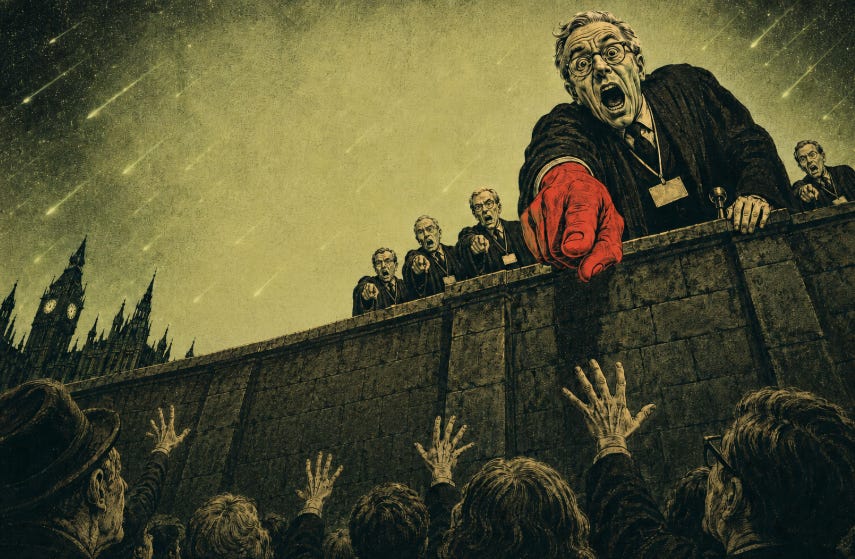
Look at the word. A horde is what you call people when you have stopped counting them as people. It is the view from a wall: a faceless mass pressing at the gate. Nobody has ever described their own friends as a horde. The word only works from above.
The worries about accuracy and effort are real worries, and I have written about them myself. The word tells you what sits underneath them. Underneath is the fear that the wrong people can now produce a polished sentence, and might be mistaken for people who belong.
For most of my life, polished prose was expensive. You paid for it with an education. You paid for it again with the free hours that come from not holding two jobs, and again with an editor or the sheer nerve to let your sentences be seen. The ability to write the way the professional classes write was a receipt. It said: someone spent money on this person. That expense kept out plenty of rubbish. It also kept out the person who thinks more clearly than they write, the person working in their third language, the person whose disability sits between the thought and the page, the person who knows the thing but was never taught how to perform knowing it.
I work in a library. Libraries exist because knowledge pools where the money is and somebody has to carry it the other way. The people on the far side of that wall are most of the people I work for.
The people on the near side did something predictable with their position. They confused the wall with intelligence. I have called them the thinking class before: the prestige thinkers who cite one another and praise one another, who pass one another around the podcasts and the panels and the conferences, and who have amplified one another for so long that their shared assumptions have started to feel, to them, like the structure of reality.
They present themselves as unusually thoughtful. What I see from some most days, on a number of platforms, is the poorest critical thinking on offer anywhere: the sweeping claim, the convenient example, no alternative considered, no sign that they understand the technology they are condemning. Many of them have plainly never sat down with a contemporary model in any serious way. They have never fed it their own evidence, told it what it got wrong, sent a draft back four times and watched how far the output bends towards the judgement of the person holding it. They tried the free version and got something bland, and they have been dining out on it since. They are experts in a caricature.
Then the apparatus arrived: Pangram scores, the browser extensions, the slop flags and the little inspection lists of sentence rhythm conducted by people who have never once been asked to justify their own. A classifier coughs up a probability or somebody counts the em dashes, and reading stops. The claims no longer need to be weighed. The person behind them no longer needs to be answered. A label that was meant to describe bad content has become a way of deciding, in advance, whose content doesn’t count.
There are no em dashes in this piece. I checked.
Every time one of these verdicts lands in my feed I hear the last minute of the 1978 Invasion of the Body Snatchers. Donald Sutherland’s character has been the hero for two hours. A woman who has survived the night sees him and comes towards him, relieved, and he turns, lifts his arm, points at her and lets out the scream. It is the pod-people’s scream, the sound the converted make to alert one another that a human is still loose. That is the sound the slop police make. They are certain they are the last people in the city who can still think.
And then I do the thing I know I shouldn’t. I open the profile. The same person looks back at me nearly every time: credentialled and comfortable, from one of the same few countries, explaining to everyone else that they have got into the conversation under false pretences. None of that makes an argument wrong. But the wall was never evenly distributed. It ran where walls always run, along money and along the map, and the people now inspecting the sentences are, nearly to a person, the ones it was built to protect. A small and extraordinarily protected group has taken its own way of expressing thought for the definition of thought, and it treats the arrival of everyone else as an infestation.
I should say where I am standing. I have a title and I sit on committees. I write from a secure job in a rich country and I use these tools every day. By the surface markers I am one of them, which is exactly why I cannot hear the phrase as anything other than what it is. I am the thinker. They are the horde. There is no kinder reading available.
What is depressing, and I mean the word, is that these are the people best placed to be generous. They have the chair or the column, and with it enough security to be curious, enough comfort to look past themselves and ask who a tool like this might let in, and what it might be like to finally say the thing you have known for years and never had the sentences for. Instead the comfort gets spent on the oldest project there is: making the self larger by making other people small.
Yes, AI produces oceans of confident rubbish. So did power and the press for centuries before anyone typed a prompt, and they are still at it. Human authorship has never guaranteed anything except that a human was in the room, and I have read enough beautifully written nonsense from credentialled people to know that polish and truth keep separate accounts. The world in which good writing proved good thinking never existed. What the thinking class is grieving is the convenience of pretending it did.
Put a better question to the text in front of you. Ask who stands behind it and whether they can explain it. Ask whether they will revise it when they turn out to be wrong, and whether they did the work to find out if it was true. Those questions apply to the person who wrote with a model and to the person with the endowed chair, and they are the only questions that ever separated thinking from its costume.
There were always more people thinking than people allowed to be heard. That is the whole horde. AI has let a few more of them through the gate, and the people on the wall have discovered that being heard was the only thing that ever made them special. So they point. So they scream.
I wrote this with AI.
I have written three essays about this and used a lot of less polite words.
That is why they still sit on my laptop.
I think I will simply link to your essay.
"The world in which good writing proved good thinking never existed. What the thinking class is grieving is the convenience of pretending it did."
Sentence of the day, so far. Great piece.