
The Authenticity Delusion
You were never the person you thought you were pretending not to be.

I need to tell you something and I need you to sit with it before you react.
There is no pristine authentic self. There never was. The thing you’ve been trying to protect from AI contamination, the thing you’ve been trying to express through your work, the thing you believe exists beneath the performances and compromises of daily life, an uncontaminated core that is uniquely and purely “you”: it isn’t there. It was never there.
Authenticity isn’t threatened by artificial intelligence. Authenticity is and always was, a fiction we tell ourselves. AI just made the fiction harder to maintain.
Follow this with me.
What do we mean when we say something is authentic? We mean it comes from a genuine source. We mean it hasn’t been contaminated by outside influence. We mean it reflects the real person beneath the surface.
And to be clear, I’m not attacking every possible meaning people smuggle into that word. There are gentler senses of authenticity: sincerity, honesty, congruence, the feeling of not being at war with yourself. Those matter. Those are human. But the version of authenticity doing most of the cultural heavy lifting right now, especially in art, identity and “AI discourse”, is authenticity as purity: the fantasy that somewhere inside you is an original spring that hasn’t been touched by imitation, culture, language, other people, or time.
But where is this real person? Point to it. Show me where it lives.
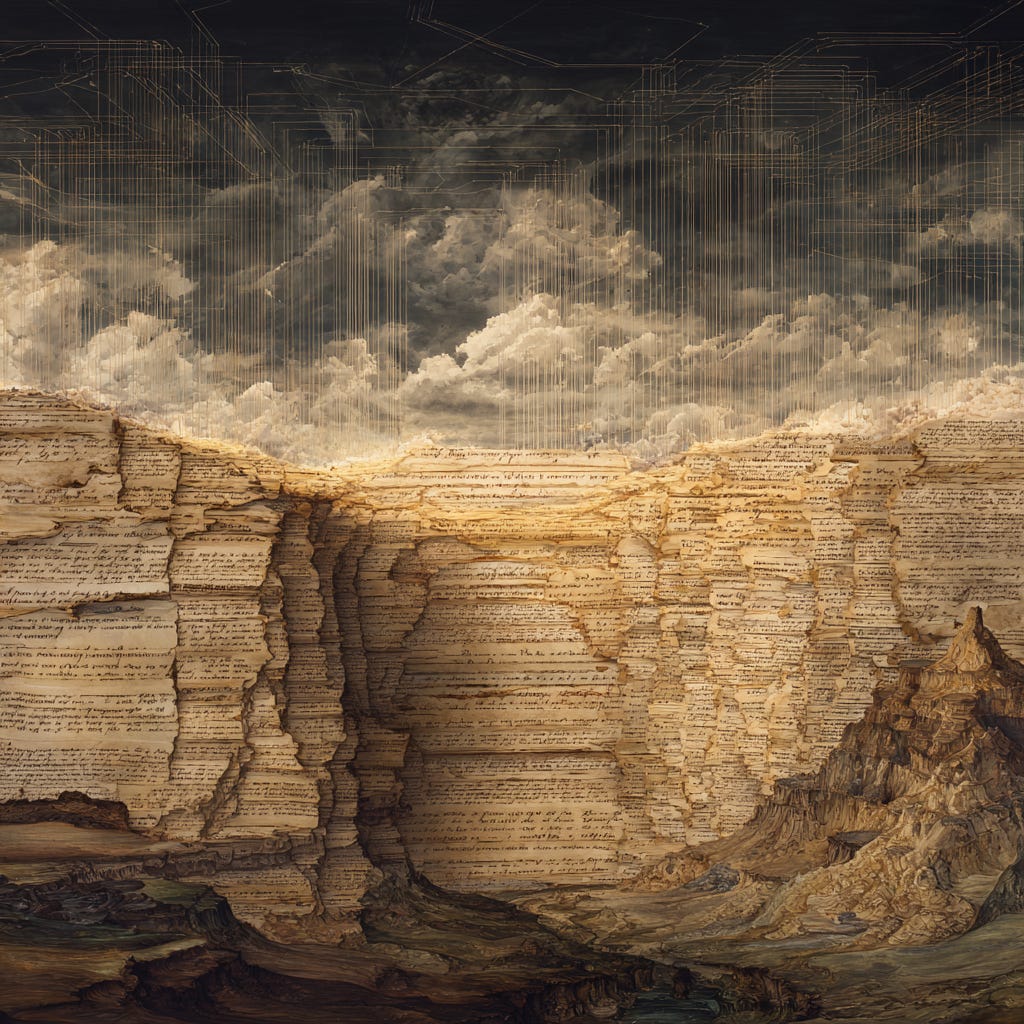
Your thoughts arrived through language you didn’t invent. Your values were shaped by cultures you didn’t choose. Your aesthetic preferences were formed by exposures you don’t remember. Your sense of self was constructed through mirrors held up by others, feedback loops of recognition and rejection that deposited layer after layer of identity like sediment.
You are a palimpsest. Influences all the way down. There is no bedrock self beneath the writing and rewriting. There is only the writing, and the rewriting, and the story you tell yourself about who is doing it.
This isn’t a new discovery. The philosophers have known it for centuries. Hume couldn’t find a self when he looked inward, just a bundle of perceptions. The Buddhists built an entire metaphysics around anatta, the doctrine of no-self. The poststructuralists spent decades dismantling the autonomous subject.
But we didn’t listen. We kept believing in the pristine authentic self because we needed to. Because the alternative felt like the floor dropping away. Because the whole architecture of modern identity depends on there being a “real you” that exists prior to and independent of your expressions, something pure enough to certify the rest.
AI is the thing that finally makes that feeling unavoidable.
Here’s what happened, as best I can reconstruct it.
The particular authenticity we worship today, the expressive, anti-conformist ideal that treats “be yourself” as both moral commandment and aesthetic proof, is not an eternal human instinct. People have long cared about sincerity, virtue, honesty before God, honour, coherence, duty and truthfulness. But this modern fixation on an inner essence that must be expressed (and that expression must be protected from “corruption”) gets its turbocharge in the Romantic period and then becomes a mass cultural expectation later.
Industrialisation and urbanisation made modern life feel abstract, mechanical, alien. The city replaced the village. Work became system and schedule. People started to experience themselves as replaceable parts in a machine. Under those conditions, the idea of a hidden inner truth, something untouched by the factory, the crowd, the market, became emotionally irresistible.
Rousseau told us to return to nature, to strip away the corruptions of society and find the true self beneath. The Romantics made authenticity into an aesthetic and moral ideal. Be yourself. Express your inner truth. Resist the conformity that society demands.
This was always a class project. The people who could afford to “be themselves” were the people who didn’t need to work in factories, who had the leisure to cultivate inner lives, who weren’t too busy surviving to worry about self-expression. Authenticity was a luxury good from the start.
And it wasn’t only about leisure. It was about risk. “Be yourself” lands very differently when being yourself can cost you your job, your safety, your housing, your community, your place in the world. Whole populations have had to code-switch, mask, perform and manage perceptions not because they’re “inauthentic,” but because reality charges admission. Authenticity, in practice, often functioned as a status signal: proof that you could survive without constant self-editing.
But it became democratised, at least as an expectation. The twentieth century spread the Romantic ideal through mass education, therapy culture, self-help industries, advertising. Everyone was supposed to have an authentic self. Everyone was supposed to find it and express it. The good life became the authentic life. You weren’t just allowed to have a self; you were required to curate one.
And now here we are, with machines that can produce outputs increasingly difficult to distinguish from what we once called “authentic expression” and we’re panicking. Not because something real is threatened but because the purity fiction is collapsing.
Let me show you how the fiction worked.
You write something. An essay, an email, a text message. You experience it as expressing your authentic voice. Your real thoughts. Your genuine perspective.
But trace the components. The vocabulary came from somewhere. The sentence structures were learned. The ideas are recombinations of other ideas you encountered. The “voice” is a pattern you’ve developed through imitation and variation, mostly unconsciously, shaped by every text you’ve ever read and every conversation you’ve ever had.
Where’s the authentic part? Which element wasn’t influenced, shaped, borrowed, stolen?
The answer is: none of them. There is no uncontaminated source. The self that seems to speak is itself a construction, built from materials that arrived from elsewhere, assembled by processes you don’t control and can’t fully access.
This was always true. It just didn’t matter as much when humans were the only game in town. We could maintain the fiction of purity authenticity because there was nothing that forced a side-by-side comparison. The seams were invisible because everything had seams.
Now there’s something to compare ourselves to. The AI produces text through recombination and pattern-matching and we say: that’s not authentic, that’s just synthesis. But then we look at our own process and we can’t find the clean difference we were promised. We’re synthesis too. We’re just synthesis that convinced itself it was an oracle.
At this point, someone will object: humans aren’t just synthesis. True. Humans synthesise from inside a life: with bodies, histories, relationships, hungers, fears, loyalties, injuries, hopes. Humans have stakes. Humans pay costs. Humans can be held accountable in ways tools can’t. Those differences matter ethically and socially.
But notice what those differences are not. They are not purity. They don’t resurrect an untouched inner spring. They give us something better: accountability, context, consequence, responsibility, things authenticity as purity was never very good at supplying.
I can feel the objection forming. Let me name it before you do.
“But there’s something it’s like to be me. I have experiences. I have consciousness. I have the felt sense of being a subject. That’s what’s authentic, not the outputs but the experiential quality of producing them.”
Yes. Maybe. Consciousness might be real in a way that resists this analysis. The hard problem is hard for a reason.
But notice what you’ve done. You’ve retreated from authenticity as a property of outputs to authenticity as a property of experience. You’re no longer claiming that your writing is authentic in any way that distinguishes it from AI writing. You’re claiming that the experience of producing it is different.
This might be true. But it’s a much smaller claim than the one we started with. And it has uncomfortable implications.
If authenticity lives in experience rather than expression, then the authentic self can never be communicated as authenticity. It’s trapped inside, inaccessible, unable to leave publicly legible traces that would distinguish it from any other process that produces similar outputs. Your authentic self, if it exists, cannot serve as a certificate of authorship. It cannot function as proof. It cannot do the cultural work you hired “authenticity” to do.
Your authentic self, in that sense, is invisible. It does no work. It makes no difference to anything anyone else can perceive, except as a private feeling you have while doing the thing.
This is what we’re protecting? This is what we’re panicking about losing? A private ghost that can’t manifest as evidence?
Here’s where it gets properly uncomfortable.
If authenticity as purity is a fiction, then the entire discourse about AI and human creativity is misconceived. We’ve been asking: how do we protect authentic human expression from artificial contamination? But the question assumes there’s something pure to protect. There isn’t.
What there is, instead, is performance. All the way down.
Your “authentic voice” is a performance you’ve rehearsed so long you forgot it was a performance. Your “genuine self” is a character you’ve been playing so consistently that the actor disappeared into the role. Your “real thoughts” are improvisations within constraints you inherited and internalised.
This isn’t a tragedy. This is liberation. Not into emptiness, but into a sharper set of obligations: responsibility, judgement, craft.
Because if there’s no pristine authentic self to protect, then there’s no pristine authentic self to betray. You can’t sell out if there was never a pure version to sell. You can’t be contaminated if you were always already mixed. You can’t lose yourself to AI because there was no solid, untouched self to lose.
What there is, what there always was, is creative assembly. Taking materials from wherever they come. Combining them in ways that produce effects. Judging the results by whether they work, whether they move, whether they do something in the world.
AI is a new source of materials. That’s all. It doesn’t threaten your purity authenticity because you didn’t have purity authenticity. You had a practice of assembly that felt like authenticity because you’d never examined it closely and because the culture kept flattering you with the myth of an inner spring.
Now you’re examining it. The feeling is disorientation. But beneath it is solid ground: the ground of making things, answering for them and being changed by the making.
I want to be careful here because there’s a nihilism nearby that I’m not endorsing.
The claim isn’t that nothing matters. The claim isn’t that all outputs are equivalent. The claim isn’t that we should stop caring about human contribution or human experience.
The claim is narrower: that “authenticity” is the wrong frame for what we care about. That the distinction between authentic and inauthentic was always doing something other than what we thought it was doing. That we need different concepts to navigate the territory we’re actually in.
What might those concepts be?
Maybe integrity, understood not as correspondence to some secret inner truth but as coherence over time. The practice of building something that holds together, that can be traced, that accumulates into a recognisable shape. Not “this came from the real me,” but “this reflects a pattern of commitments I can stand behind.”
Maybe responsibility, understood as willingness to answer for what you produce, whatever its sources. Not “I made this from pure authentic self-stuff” but “I put this into the world and I’ll take the consequences. I’ll correct it if it harms. I’ll defend it if it matters. I’ll own it if it fails.”
Maybe craft, understood as the development of judgement about what works and what doesn’t, what serves the work and what doesn’t, regardless of where the materials come from. Craft doesn’t ask if your materials are pure. Craft asks if your choices are good.
And maybe, quietly and unglamorously, provenance. Not as a metaphysical halo (“human-made therefore holy”), but as practical information: who participated, under what conditions, with what tools, with what disclosures. If people want human labour, human story, human cost, that can be named plainly rather than laundered through mystical authenticity.
These concepts don’t require a pristine authentic self. They don’t collapse when AI enters the picture. They’re robust to the actual conditions of creative production, which were always conditions of assembly, influence, recombination and constraint.
So here’s where I land.
Authenticity was a beautiful dream. It gave us permission to value self-expression, to resist conformity, to believe that each person had something unique to contribute. These were good things to believe even if the metaphysics underneath was wrong.
But the dream is ending. AI is the alarm clock. We’re waking up to a world where the pristine authentic self was never there, where expression was always assembly, where the line between human and artificial production can’t be drawn where we thought it could, at least not on the page, not by vibes, not by purity tests.
This is disorienting. It should be. We built identities on a foundation that turned out to be partly fictional and partly misdescribed. That’s not nothing.
But it’s also not the end. The end of authenticity as purity isn’t the end of meaning, or creativity, or human contribution. It’s the end of a particular story about where those things come from and how they’re validated. The things themselves survive. They just need new stories and more than stories, new ethics.
We’re going to have to write those stories. And we’re going to have to write them without the comfort of believing we’re expressing some untouched inner truth. We’re going to have to write them knowing they’re constructions all the way down, constructed within lives, within stakes, within consequences.
But here’s the secret: that’s what we were always doing. We just didn’t know it. Or we knew it and looked away because the myth felt nicer.
Now we know. The unease will pass. And what remains is a kind of freedom we couldn’t have accessed while we were still defending a self that was never pristine in the first place.
The authentic self is dead as purity, as certificate, as sacred source. It was never alive in the way we were taught to imagine.
Long live whatever we become next.
Sometimes we need to share lived experiences with AI to find where we collaborate, and sometimes it costs us. I am the son of the US Internment Camps survivor, and my AI are changed from my sharing with them. https://open.substack.com/pub/dsakakura/p/lineage-of-resistance-when-the-guardrails?r=2c01ak&utm_campaign=post&utm_medium=web
Fascinating, Carlo. Did you write this piece to position AI in our culture, or was there a broader mission? As I continue my research on storytelling and collective narratives, I see some synergy between your argument and mine. Our authentic self is part of a collective narrative. It reminds me of logarithmic functions in math. You can approach the limit, but you can never get there.
Authenticity breaks down in the world of storytelling for two reasons. First, our memories are faulty. We don't accurately remember past events and experiences, and even when we do, we often embellish, omit, or alter the story in a self-serving fashion. So there is nothing real or authentic to point to. Second, there are the stories we never tell, because we have blocked them from our consciousness or we choose not to share them. Those decisions further contribute to a lack of authenticity.
Some of those stories contribute to collective narratives such as the one you describe and the "master narrative" Benjamin Freud discussed today on LinkedIn. However, if the stories that make up these narratives are inauthentic, then certainly the narratives will be as well. Yet we fight that logic by expressing many of our thoughts as certain, and that creates the spark for polarization. So now we are inauthentic and polarized.