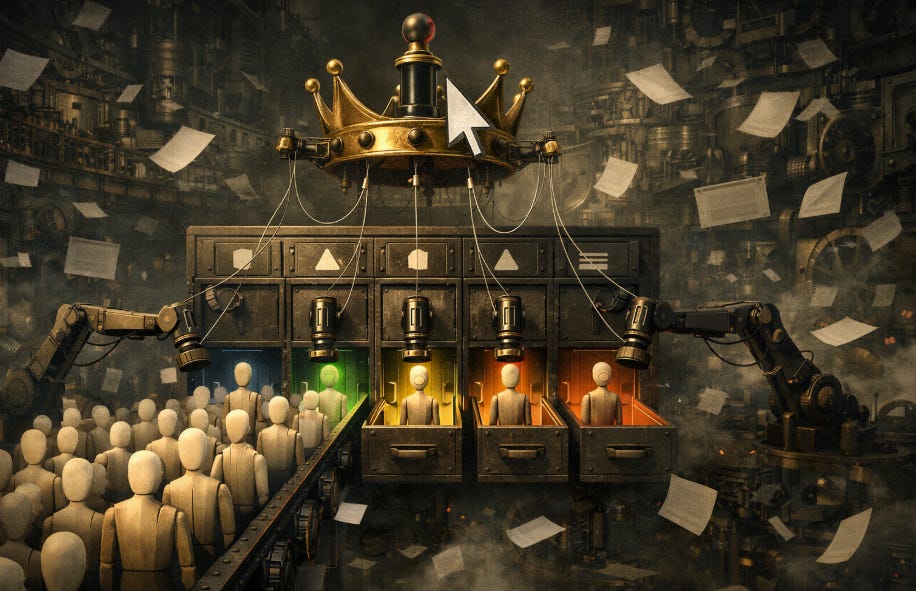
NPC Thinking
The Shortcut That Pretends It Isn’t

I was halfway through Gurwinder’s Substack post about “NPCs” when I felt that familiar, slightly embarrassing sensation: the pleasure of being offered a clean map of a messy world. Five categories, neat boxes, crisp edges. The promise was seductive in the way a well-designed flowchart is seductive. There are people who truly think, and people who merely run. If you learn to spot the difference, the world stops being confusing. You stop wasting time on the wrong conversations. You stop getting tricked by the crowd.
It’s a relief, that framing. It makes social life feel legible. It gives you a little throne to sit on while everyone else shuffles past in pre-written dialogue.
The trouble is that the relief is doing most of the work.
I don’t mean this as a scolding. I mean it in the same way you notice you’ve been holding your shoulders up around your ears and didn’t even realise until you let them drop. The “NPC” frame offers a posture: a way of standing above the swarm. It’s less an argument than a stance. It promises diagnosis, but what it delivers is closure.
I’d already been chewing on that thought when I heard the term deployed properly, away from essays and screens, out in the air where people’s faces still have to react in real time. It was in the kind of conversation that starts as banter and slowly turns into politics without anyone consenting to the genre shift. Two people disagreeing about something small and hot—one of those topics where you can feel the algorithms standing behind the speakers like ventriloquists. One of them, growing impatient, smiled and said, “You’re such an NPC.”
The other person laughed, because that’s what you do when someone turns your interior life into a joke and you’re not sure whether to fight or defuse. But the interesting thing wasn’t the laugh. It was the face of the person who’d said it. Their expression softened, the way it does when you’ve finally found the right key for a stubborn lock. Not triumph exactly. More like satisfaction. As if a complicated problem had just become a simple one.
Because in a way, it had. The moment you call someone an NPC, you don’t have to understand them anymore. You don’t have to track their reasons, or their fears, or the incentives shaping their beliefs, or the information they’ve seen, or the trade-offs they’re making. You don’t even have to be curious about how a mind different from yours could arrive somewhere else. The label does something magical and ugly: it converts disagreement into a verdict about personhood. You’re no longer dealing with an agent; you’re dealing with scenery.
In games, “NPC” is a technical term, almost affectionate. Non-player characters are the shopkeepers, guards, quest-givers, background citizens. They are the infrastructure that makes the player’s story possible. Their predictability is what lets the world feel stable enough for your drama to happen in it. When the term becomes an insult, that origin matters more than people admit. The contempt isn’t really for thoughtlessness. It’s contempt for the roles that keep things running while someone else gets to feel like the hero.
That’s why the frame spreads so easily. It doesn’t just sort other people; it promotes the speaker. It quietly appoints you the player in a world of automata.
The Substack version dresses this up as cognitive hygiene. Humans are “cognitive misers”, the story goes, so they rely on mental shortcuts; some people never shake those shortcuts and spend their lives repeating scripts. There’s truth in that. People do parrot. People do conform. People do say things because their team says them. Anyone who has been to a family dinner, or an office meeting, or the comment section of literally anything knows this.
The problem is what happens when you hand someone a taxonomy and tell them it’s insight. The boxes become the thinking. The moment you have categories, you can “understand” a person without the discomfort of engaging them. You don’t have to ask why they believe what they believe, you just identify which type they are. The frame becomes a labour-saving device that feels like discernment. It gives you the sensation of having done the work of reasoning when all you’ve really done is apply a label.
This is what cheap frameworks always do. They turn complexity into a vibe. They convert curiosity into sorting. They give you a little dopamine for recognising a pattern, then quietly discourage you from checking whether you’re right.
The deepest assumption beneath the NPC story is even more flattering: that there exists a way of thinking that is truly unborrowed, unshaped by the social world, a mode of cognition that is purely yours. If you just tried hard enough, you could arrive at beliefs that weren’t inherited, delegated, or socially reinforced. You could be the kind of mind that stands alone.
That idea has a certain heroic beauty. It is also, for most of human history, basically nonsense.
Human cognition has never been a solo sport. We are built to learn from others, to defer, to imitate, to outsource. Not because we are weak, but because reality is too large and time is too short. Even the most “independent” thinker you know is standing on a mountain of other people’s testimony. They did not personally verify the germ theory of disease, or the details of how semiconductors work, or the structural integrity of bridges, or the safety procedures that let planes land. They defer because they must. We all do. Modern life is a giant cooperative project in which we trade trust for functionality.
And that’s before you get to the fact that time is not distributed evenly. The fantasy of the autonomous rational thinker tends to belong to people who have the luxury of autonomy: time, education, safety, the ability to sit with uncertainty and treat every belief as a personal research project. If you can afford to read widely, cross-check sources, argue in public, and be wrong without losing your job or your community, “thinking for yourself” looks like a moral achievement. If you’re keeping children alive, paying rent, working shifts, caring for a body that is tired, then “thinking for yourself” often means something more modest and far more sensible: trusting people and institutions with decent track records, and getting on with the rest of life.
When people sneer at that as NPC behaviour, they’re not diagnosing a cognitive failure. They’re revealing a failure to understand constraint. They are mistaking limited bandwidth for moral deficiency. They are confusing “doesn’t perform deliberation for me on demand” with “doesn’t have an inner life.”
That’s part of why the insult is so often pointed in predictable directions. It is almost always deployed downwards. The person calling someone an NPC is positioning themselves as the protagonist and demoting the other person to a background role. They rarely use it on someone with power over them. They rarely use it on the people who control institutions, shape incentives, and write the rules of the game. They use it on people who are socially safe to diminish: the normie, the worker, the stranger, the colleague who says the wrong line from the wrong script. It’s a dominance move dressed as epistemics. You’re not just saying, “I think you’re wrong.” You’re saying, “Your reasons don’t count as reasons.”
Once you notice that, the term gets a darker edge. Because this is how soft dehumanisation works. It doesn’t arrive with a grand ideology. It arrives as a joke, a meme, a label that lets you treat a person as less real. It trains you into a habit: when faced with friction, downgrade the other person’s interiority. Stop modelling them as a mind.
The depressing twist is that the people most confident they aren’t NPCs are often the most captured by a different script. Not the mainstream script, the special script. The script where you are one of the rare awake ones. The script where your disagreement with the crowd proves your superiority. The script where “I’ve done the research” becomes a sacred phrase that means “I have found sources that flatter my self-image.”
This is where the whole thing eats its own tail. The NPC accuser tends to imagine they have escaped social influence, but what they’ve usually done is switch which group they defer to and rename it independence. The need to belong doesn’t vanish; it changes costume. The status game doesn’t end; it rebrands itself as scepticism. Even contrarianism can become a form of conformity, complete with its own shibboleths, its own heroes, its own canned lines, its own warm sense of being among the enlightened.
If you want an uncomfortable diagnostic, it’s not “do you ever take cognitive shortcuts?” Everyone does. It’s “do you feel a little rush when you sort people into the ones who think and the ones who merely process?” That rush is the tell. That rush is your brain getting paid for ending curiosity.
And I keep coming back to the single most revealing detail from that real-world moment: the relief on the speaker’s face. It was the expression of someone who didn’t have to do the hard work of encountering another person anymore. The label let them step out of uncertainty and into certainty. It let them stop wondering whether they might be missing something. It let them stop holding the tension of two plausible stories at once. It let them win without understanding.
That’s why I don’t think the NPC frame is primarily about cognition at all. It’s about the management of discomfort. It’s a technology for turning complexity into contempt.
If you actually care about thinking—real thinking, the kind that hurts a bit—you end up in a very different place than the NPC taxonomy wants to take you. You end up noticing how much of your own mind is borrowed. You end up recognising that everyone is running some kind of script because scripts are how finite beings function. You end up asking, not “is this person programmed?”, but “what pressures and incentives and information would make this belief the sensible default for them?” You end up less interested in whether someone is a protagonist and more interested in what world they’re living in.
That posture doesn’t feel like victory. It feels like being stuck in the middle of things, aware that you are probably wrong in ways you can’t see, and that other people’s reasons might not be stupid even when they’re different. It doesn’t give you the glamour of the lone player in a world of bots. It gives you humility, which is a deeply unsexy emotion on the internet.
But it has one advantage. It keeps you from turning other people into props.
I don’t think the thoughtful response to the offending Substack is to protest, earnestly, that you are not an NPC. The more interesting response is to notice how much you wanted that reassurance. How hungry you were to be categorised as real, awake, autonomous. How quickly the taxonomy offered you a flattering story about yourself.
That hunger is the real subject here. Not other people’s shortcuts. Your own desire to believe you don’t have any.
The world is too complicated for anyone to live without delegation. The honest question isn’t whether you outsource your beliefs; it’s whether you understand what you’re outsourcing, and to whom, and why. The honest question isn’t whether other people are running scripts; it’s whether you can admit the scripts you’re running without needing to declare yourself the main character.
The NPC frame promises a clean division between thinkers and non-thinkers. In practice it mostly divides the world into people you are willing to grant interiority, and people you are not. And once you see that, the term becomes less a critique of cognition than a confession of incuriosity.