
For the Generalists
This is for the people who were told their attention wandered.

Their attention landed. It just landed in places the system had not labelled as career.
The point was appetite, not brilliance across the board. Most of us were good at a few things, ordinary at plenty and bad enough at some to remember the bruise. The truth was simple. You were hungry.
You liked the first week of a new field, when the nouns were still strange and the diagrams had not yet become furniture. You liked the part before fluency, when every sentence sent you to another tab, another book, another person who knew more than you did. You liked the moment when a problem in one place began to resemble a problem from somewhere else.
By the seventh week, when fluency had set in and the diagrams had become wallpaper, some of you found another tab open and a new thing pulling. The hunger was the engine. It only looked like distraction to the people who needed you to stay still.
This is for the people whose CVs make recruiters slow down. Libraries, learning, systems, policy, data, writing, AI. Teaching here, strategy there, some odd little detour that only looks odd if you read careers as ladders. To the recruiter, the movement can look like a series of small betrayals: too much range, too little settling, no single tribe. To you, it was a pattern. You were following the question. You were following it even when the question led somewhere your career was not supposed to go.
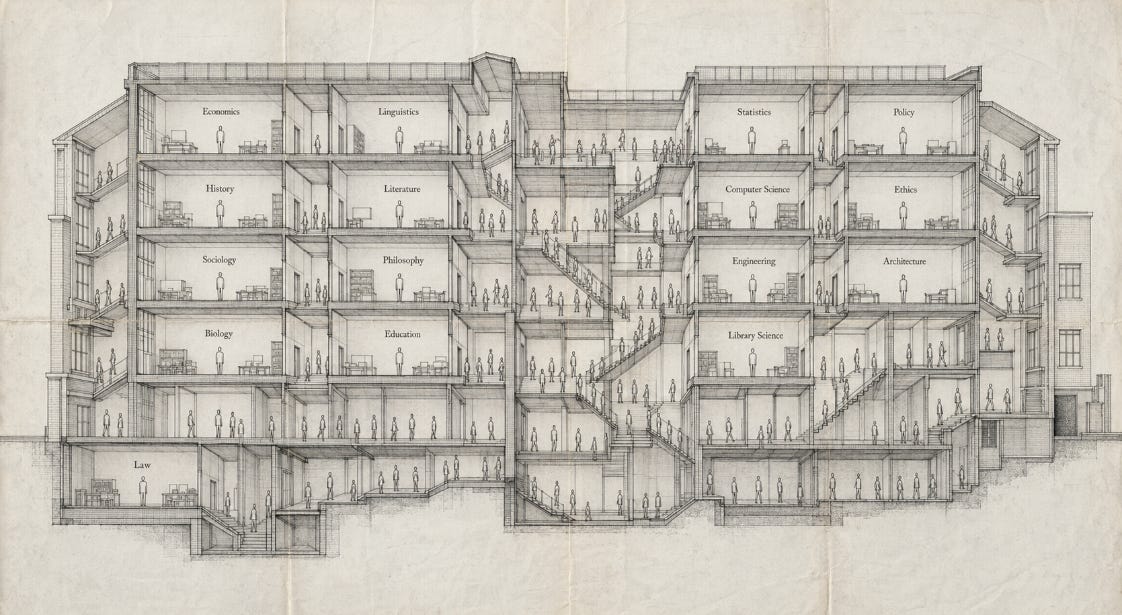
For most of the last half century, the institutions that hand out the clean careers have had poor eyesight for this kind of mind. They wanted to know your discipline. Your school. Your method. Your professional body. They asked which room you belonged in, and you kept giving them the answer they did not have a box for.
You belonged near the catalogue, the corridor, the hinge between rooms. You belonged where the naming happened.
So you learned to perform a single room. You picked the room that paid, or the room that would have you, or the room you were tired enough to settle into. You put the rest in a folder labelled hobbies, weekends or later. You learned the journals of the room you were in. You stopped citing the books that did not belong there. You let the other shelves gather dust.
It was not free. Performing a single note has a cost most institutions never measure. Editing yourself in real time. Filing your odd questions for after the meeting. Reading the room’s temperature before you spoke. The bill arrives in tiredness. The tiredness gets misread as something else.
You learned to be quiet. Not modest, not deferent, just quiet. You learned the difference between rooms where you could say what you thought and rooms where the price was too high. You kept the wider mind for the page, for the walk home, for the kitchen at midnight. You brought only the safest shape of it into the meeting.
You learned that your thinking takes time. The room moved at the speed of speech and your thinking moved at the speed of weighing. You needed the long pause. You needed the question to settle before the answer arrived. The room mistook the speed of speech for the speed of mind. The people who answered first kept being treated as the people who answered best.
You knew they were not always the same people.
We do not have a good vocabulary for what is lost when a person who can move between domains is trained to pass as one kind of professional. They become useful. They become legible. They become hireable. They also become quieter than they ought to be, in a register the institution does not measure and therefore does not miss.
The dismissals were rarely dramatic. Mostly they arrived as tone. A small note of concern that you should probably pick something. A smile when you asked a question from the edge of someone else’s field. A warmer welcome when you stayed in your lane. The lane had its own price. It was a payroll category with manners.
You got good at reading those notes. You had to. The same sensitivity that made you wince at the smile in the meeting also made you the person who could feel an institution lying long before it admitted it. That was its own intelligence, and the institution did not have a name for it.
A problem rarely arrives wearing the badge of one discipline. It turns up mixed: a technology problem tangled with language, a learning problem tangled with trust, a policy problem tangled with behaviour, a service problem tangled with memory and fear and money. The interesting question is often the one nobody in the room can quite ask, because the words for it live on another shelf, or because the question would disturb the room’s customs.
Generalists notice shelves. The labels on them. The gaps between them. The way a field has agreed to file something under one heading and the way that heading has begun to lie. The way a custom has hardened into a fact. The unspoken rule everyone in the room is following and nobody can quite point to.
This is what the system often misreads. It calls restlessness flightiness. It calls movement between fields a failure of depth. It looks at sustained focus on something the room thinks is small and calls it strange. The same question asked in three forms gets called stuck. A person who would rather say “I do not know” than perform the right shape gets called difficult.
The institution has a name for almost everything except the thing it has not yet learned to value.
Sometimes the misreading is fair. There is a shallow version of range. Generalists know it better than anyone. Five smooth paragraphs across five fields is tourism with a confident font. Synthesis is something else.
Real range feels different from the inside. It is slower. You spend a long time being the person in the room who knows enough to listen but not enough to perform certainty. You learn the weight of words before you use them. You learn which questions anger people because they expose the scaffolding. You learn when a field has mistaken its customs for truth.
You also learn humility, if you are paying attention. Every new field begins by making a fool of you. It shows you what you did not know you did not know. It introduces you to people who have spent twenty years on a corner you had barely noticed, and you recognise something in them, because you have given the same long attention to corners they have never seen.
That should cure the cheap kind of generalism. If it does not, you were never a generalist. You were just passing through with good shoes.
The better version is harder and more useful. It carries things across borders without pretending the borders are fake. It knows when to call the specialist. It knows when the specialist is answering the wrong question very well. It knows that fluency is not the same as understanding, and that understanding often begins in the awkward pause before the right vocabulary arrives.
For a long time, the generalist’s gift was treated mostly as perception. You could see that the design problem was also a language problem, that the information problem was also a trust problem, that the AI problem was also a library problem: retrieval, judgement, provenance, authority, use. You could hold the pattern in your head. What you often could not do was build from it without a team, a budget, a gatekeeper or a six-month business case that died in committee with a sandwich tray beside it.
That bottleneck shaped the work before the work began. It decided which ideas were allowed to become real and which stayed charming in meetings. Some gatekeepers were generous. Others were merely tired. A few had built whole careers out of saying no in the language of prudence.
The bottleneck has loosened.
Not everywhere. Not cleanly. Not without risk. But enough. The cost of moving from a connection to a rough working thing has fallen sharply. A person with judgement can sketch a service, query a dataset, draft a policy, test a workflow, build a crude interface, compare sources, make a case and see where the idea breaks before Monday has finished doing its damage.
The old tax on implementation has dropped. That tax was one of the main things keeping range in its place.
This is not because tools are wise. They are not. They are fast, suggestive, obedient and often wrong in ways that sound expensive. But they reward a certain kind of mind: the person who knows how to ask the next question, where an answer might come from, what should be checked, when a source is thin, when a model is bluffing and when the tidy sentence has outrun the truth.
They reward the person who can move between the tool, the task, the user, the institution and the consequence. They reward the person who can sit with a question long enough to notice what the room has agreed not to see.
The slow thinker, the wide thinker, the person who needed the pause, finally has tools that wait.
That is the generalist’s ground.
Narrow fluency will still be needed, especially where the problem goes deep and the cost of error is high. We will still need the people who know the thing down to the bone. We will need them nearby, respected, properly paid and occasionally protected from the rest of us.
But expertise is not a single shape.
The person who can connect fields without flattening them is doing expert work. So is the person who can hear the same problem being misnamed in three departments. So is the one who can translate between policy, practice, technology and ordinary human reluctance. The person whose attention has always been a little hungrier than the room expected is doing expert work too. So is the person whose thinking has always taken its own time.
It has taken our institutions a long time to notice, because their forms were badly designed.
So this is for the people who kept learning sideways.
For the people who were not prodigies, not dilettantes, not lost. For the people who followed a question through libraries, systems, classrooms, committees, code, books, conversations and the awkward silence after someone says, “That is not really our area.” For the people who learned to be quiet in the rooms that did not have time for them. For the people whose minds were never built for a single corridor and who finally have tools that match the shape of how they think.
You do not need to apologise for the shape of your mind.
You do need to honour it.
Feed it properly. Read past the first result. Learn enough of the field to know when you are being superficial. Keep the specialists close. Build rough things before you make grand claims. Take the time you need. Let the work prove the connection.
The generalist was never required to know everything.
The work was to keep the catalogue open, to notice the bad labels and to walk across the corridor before anyone had given the corridor a name.
This one is for you.
The distinction worth adding to this: the tools are not only an accelerator but primarily an amplifier. An accelerator gets you there faster. An amplifier depends entirely on what you're putting in. For the curious mind — the one that knows which question to ask next, which result to distrust, which connection hasn't been named yet — the return is disproportionate. The tool doesn't generate that. It multiplies it. Which also means it multiplies the absence of it, for the mind that was never really hungry to begin with.
I get this SOOO much