
Cold
some nights the world looks to break you

Not in any dramatic way. Not the kind of breaking you’d recognise if someone described it. More like a fracture that runs through everything at once, so quietly you only notice when you stop moving.
I’ve been reading a government report about the end of the world. That’s not what it calls itself. It calls itself the Nature Security Assessment on Global Biodiversity Loss, Ecosystem Collapse and National Security. Fourteen pages, published in January by HM Government, written in the careful, bloodless language of intelligence analysis. Probability yardsticks. Analytical confidence ratings. The prose of people trained to describe catastrophe without flinching.
The report says that every critical ecosystem on the planet is on a pathway to collapse.
It says this with high confidence.
I should tell you what I was doing before I opened it. I was watching the news. I don’t need to tell you which footage, which country, which conflict. You know. You’ve seen the images. The small bodies carried through rubble. The faces that could be any face, could be your child’s face, flattened into something a commentator will call “the situation” before cutting to a correspondent standing in front of a map.
We have become fluent in the grammar of not-seeing. We know how to watch a child pulled from concrete and feel the appropriate three seconds of horror before the algorithm serves us something else. We know how to sort the dead into categories: ours and theirs, deserving and collateral, tragic and inevitable. We have built entire political architectures on the premise that some lives are background noise.
And then I opened a PDF about biodiversity.
The connection isn’t metaphorical. I want to say this clearly, because the instinct will be to treat it as a writer reaching for a poetic link between two unrelated things. It isn’t. The inability to see a person behind an allegiance and the inability to see a living system behind a resource are the same failure. The same muscle. The same dead nerve.
The report identifies six ecosystems of strategic importance: the Amazon, the Congo Basin, the boreal forests, the Himalayas, Southeast Asia’s coral reefs and its mangroves. It maps their collapse pathways with the calm of an actuary pricing a funeral. The Amazon is at 17% deforestation. The likely tipping point sits between 20 and 25%. After that, rainforest becomes savannah. The word “irreversible” appears more than once.
Coral reefs: 84% of the world’s reef area has experienced bleaching-level heat stress in the past three years. Some have already passed what scientists call hard adaptation limits, the threshold beyond which no amount of adjustment preserves function. They are not dying. They have been killed. The grammar matters.
Monitored wildlife populations have declined by 73% since 1970. That is not a percentage in a spreadsheet. That is the world becoming quieter, thinner, less alive, while we argued about growth.
I turned off the screen and went outside.
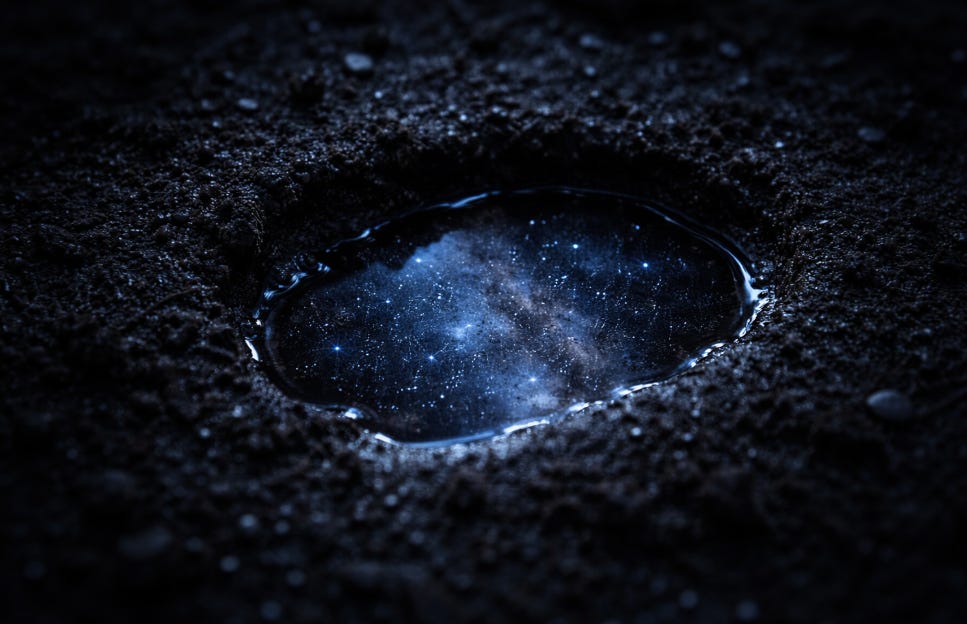
It had rained. The first real rain in what felt like too long and the ground was still drinking it in. You could smell it, that particular scent the earth releases when water finally arrives, the one scientists gave a name to, petrichor, as if naming it could contain what it actually is: relief so deep it comes from the soil itself. Early autumn in regional New South Wales. The heat breaking. The stars still visible between the clouds, impossibly dense the way they are out here, where the light pollution hasn’t reached.
I stood in the wet grass and breathed and thought about water.
The report talks about water constantly. Water as a security concern. Water cycles disrupted by deforestation. Water scarcity driving conflict. The Himalayas losing the glacial melt that feeds rivers sustaining billions. Water as the thing that connects every system to every other system, the thing we treat as a given until it isn’t there.
Rain was falling on my garden. And somewhere, aquifers were emptying. Somewhere, a river that used to reach the sea no longer does. The same substance. The same molecule. Arriving here, disappearing there. I could feel the relief of it on the ground beneath my feet and I could feel something else entirely when I thought about what I’d just been reading.
My children were sleeping inside. They will be in their twenties by 2040. The report assesses that rainforests and mangroves could begin collapsing from 2050.
I thought about what it means to read, with high analytical confidence, that the systems sustaining human civilisation are degrading faster than governance can respond and then go back inside and look to sleep.
The report does something unusual for a government document. It names the cascading logic. Ecosystem collapse doesn’t stay ecological. It becomes food insecurity. Food insecurity becomes migration. Migration becomes political instability. Instability becomes conflict. Conflict becomes the footage I was watching before I opened the PDF.
A heatwave in Russia in 2010 destroyed the wheat harvest. Russia banned exports. Global food prices spiked. The price of bread helped tip several countries into the uprisings we later called the Arab Spring. One weather event. One crop. And then the dominos, which were never dominos at all but people, falling.
The UK imports 40% of its food. It cannot feed its population on current diets. The report states this without drama, as if it were simply accounting.
Which perhaps it is.
The financial architecture tells you everything about who we actually are, as opposed to who we claim to be at summits. Roughly seven trillion dollars a year flows into economic activity that actively damages the natural world. Investment in nature-based solutions sits at around two hundred billion. We are spending thirty-five times more to destroy the systems that keep us alive than to protect them. We have known this for years. We have documented it, published it, presented it in rooms with flags and translators and then we have continued.
Seven of nine planetary boundaries have now been crossed, one more than when the report was drafted. 2024 was the first calendar year where the global average temperature exceeded the pre-industrial baseline by more than 1.5 degrees Celsius, the line the Paris Agreement was built to hold. We crossed it. The agreements we celebrated. The photographs of leaders shaking hands. The champagne.
And tonight, somewhere, a mother is carrying a child through dust that used to be a building. And the reef is bleaching in water that used to be cool enough. And the forest is thinning on land that used to hold rain. And I am standing in my garden where the rain has finally come, and the ground smells like forgiveness, and I feel cold in a way that has nothing to do with temperature.
IPBES, the global body tasked with assessing biodiversity, identified the underlying causes of ecological destruction. They were not ecological. They were: disconnection. Domination. Concentration of power and wealth. Prioritisation of short-term material gains.
Read that list again. Then tell me it doesn’t describe exactly how we produce the news footage too.
This is what I keep circling. The mechanisms are the same. The logic that allows a government to classify people as threats rather than humans is the same logic that allows an economy to classify a forest as a resource rather than a living system. The failure is not ignorance. We have more data than any civilisation in history. The failure is recognition. We look at what is alive and see what is useful, and when it stops being useful we look away.
A resilience strategy built on extraction and inequality is not resilience. It is the problem wearing a lanyard.
My father would say something simpler. He’d say you can’t keep taking and not expect it to run out. He’d say it about a neighbour who borrowed tools and never returned them, or a politician who made promises during an election. The scale changes. The principle doesn’t.
I don’t have a framework for this. I don’t have a reframe or a way of holding it that makes the weight feel manageable. I have a government report that says, in the restrained language of security planning, that the living systems underwriting civilisation are collapsing, and I have a television that shows me, every evening, that we cannot see each other as human across a border or a faith or a colour of skin.
These are not two crises. They are one crisis wearing two faces. And the night sky doesn’t care which one you look at.
I went back inside. Checked on the kids.
I write because it is the only thing I know how to do when the weight gets like this. Not because writing fixes anything. It mostly doesn’t. But the alternative is to absorb it in silence and silence at this scale starts to feel like agreement.
So here it is. Not an argument. Just a record of a night when the rain came and I read about the world ending in two languages at once.
The stars were still there, between the clouds. They’ll outlast all of it.
I don’t find that comforting.
I wrote 1000ish words this morning in my journal that expresses, in a very non linear messy way, what you wrote so articulately in your piece, Cold. Thank you. Somehow it helped. Less pressure on my heart of the human destructive insanity when it could be otherwise problem by knowing I'm not the only one that sees it? Not sure. As I write, it has started snowing again. I'm ready for some warm.
It’s a blunt report isn’t it. From a government agency. Did it get a second’s coverage in the UK I wonder?
Thanks Carlo for words that express what many of us are processing these days. What gives me hope aren’t the people who insist we can fix this, but those who can stay with the trouble, have worked through the grief you’re talking about, and come out the other side intact.
Next, they are committed to helping others on that journey.
And then they’re asking how we equip our children.
What also gives me hope is remembering that many Indigenous cultures have faced the end of the world as they knew it, and survived (and from whom we have so much to learn).
And I don’t disappear into a nihilist spiral because I don’t believe that our three score years and ten as carbon-based lifeforms on a small rock is the totality of our existence. The universe is so much more entangled, wonderful and loving. But it’s times like these that test my conviction.
As a librarian, you may also appreciate “What a Librarian is Reading in Times of Moral Nausea and Psychological Despair” https://cardcatalogforlife.substack.com/p/what-a-librarian-is-reading-in-times