
Are AI Language Models Learning to Reason?
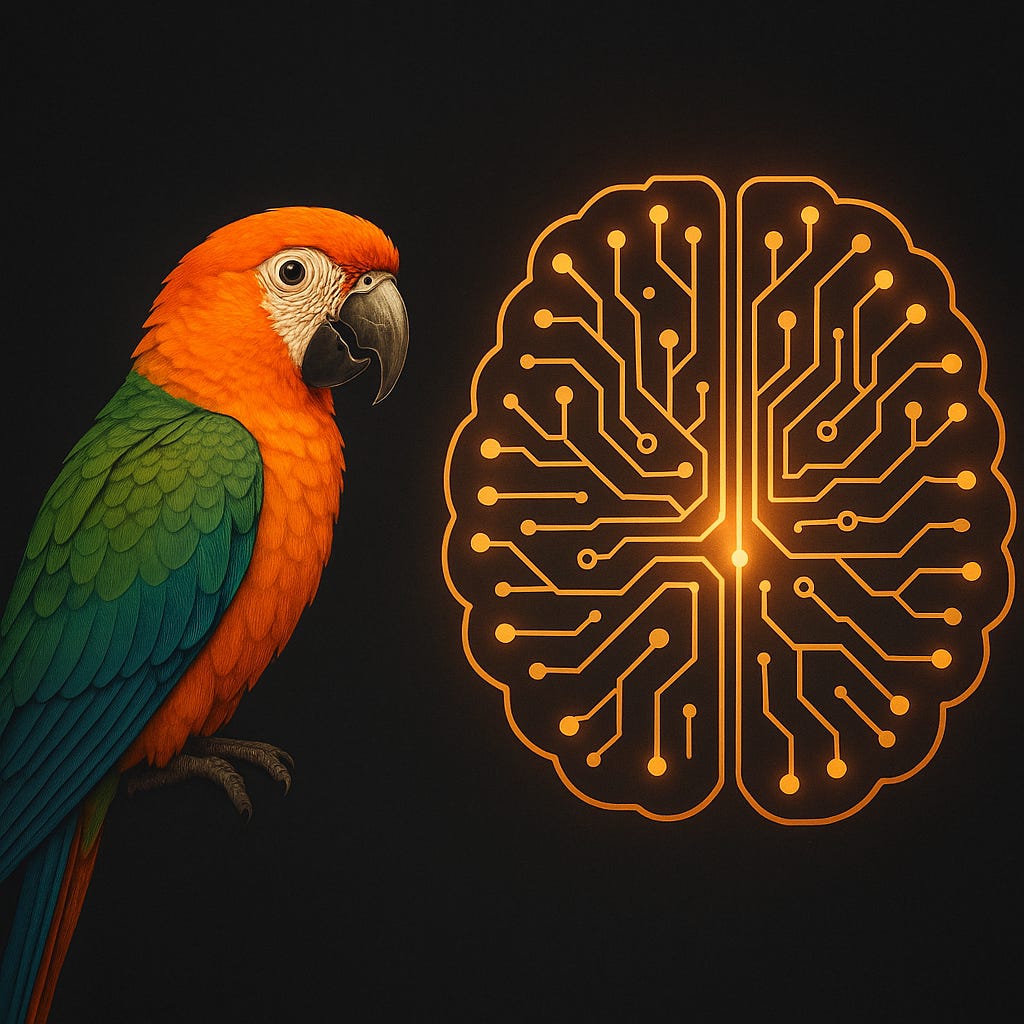
Beyond the Stochastic Parrot

Abstract
Artificial Intelligence (AI) language models, like Anthropic's Claude, have become incredibly skilled with language. But are they just mimicking human text like sophisticated 'stochastic parrots', or are they actually starting to understand and reason? This article explores recent research that tries to look inside these AI 'brains' to see how they work. Using methods that map out the AI's internal steps, researchers have found clues suggesting these systems might be doing more than just repeating patterns. I look at evidence showing they can perform multi-step thinking, plan ahead, grasp concepts across languages, use learned skills in new situations, handle information in multiple ways at once and even show signs of basic self-awareness. These findings challenge the idea that these AIs are only mimicking and suggest something more complex might be developing. I explain the methods used in simple terms, describe the evidence found, and discuss what this could mean for the future of AI.
Introduction
AI language models are everywhere now, writing text, answering questions and generating computer code with impressive skill. But a big question hangs over them: are they truly intelligent, or just incredibly good impersonators? One popular critique labels them as "stochastic parrots", systems that cleverly stitch together words based on statistical patterns learned from massive amounts of text, without any real understanding of what they're saying (Bender et al., 2021). They repeat, or 'parrot', patterns they've seen, making statistically likely ('stochastic') guesses for the next word.
However, another possibility is that as these models get bigger and are trained on more data, they start to develop internal ways of representing information and solving problems that go beyond simple mimicry. Could they be learning to reason, plan and understand in some meaningful way?
To investigate this, researchers are working on ways to peek inside the 'black box' of AI. This field, sometimes called 'mechanistic interpretability', tries to figure out the step-by-step processes happening inside the AI when it generates an answer. Research labs like Anthropic have published findings, often on their websites or related technical blogs (like transformer-circuits.pub), using these techniques to study advanced models like Claude.
This article brings together these findings, focusing on evidence that suggests AI language models might be moving beyond the 'stochastic parrot' stage. I'll explain how researchers are looking inside these systems, detail what they're seeing that hints at deeper capabilities and discuss why it matters.
Why It's Hard to Understand AI
Modern AI language models are built using complex designs called 'Transformers' (Vaswani et al., 2017). These involve billions of connections, similar to a vast network of virtual neurons. This complexity makes them powerful, but also very difficult to understand from the outside. We can see the final answer the AI gives, but figuring out how it arrived at that answer is a major challenge. This lack of transparency is a problem for trusting AI, fixing its mistakes and making sure it behaves safely and as intended. That's why researchers are developing ways to make these internal workings clearer.
How Researchers Look Inside AI
Imagine trying to understand how a complex machine works without a manual. Researchers studying AI internals face a similar problem. They've developed clever techniques, highlighted in the Anthropic and transformer-circuits.pub materials, to map out the AI's internal 'thoughts':
Finding the Concepts: Instead of looking at individual virtual 'neurons' (which can represent many confusing things at once), researchers use methods to identify specific 'features' inside the AI that seem to correspond to understandable concepts – like the idea of 'London' or the concept of 'happiness'.
Simplified Stand-ins: Sometimes, complex parts of the AI are temporarily replaced with simpler components that are easier to analyse but do the same job. Think of replacing a mysterious black box in a machine with a clear box that performs the same function. This allows researchers to understand the transformations happening inside (discussed in resources like transformer-circuits.pub/2025/attribution-graphs/methods.html).
Creating 'Thought Flowcharts' (Attribution Graphs): Using these identified concepts and simpler components, researchers can create diagrams, like flowcharts, called 'attribution graphs'. These charts show how different concepts or pieces of information are activated and influence each other, step-by-step, as the AI works towards its final output for a specific question. It's like tracing the chain of thought the AI followed.
These techniques allow researchers to go beyond just guessing and actually observe the internal processes involved in the AI's behaviour.
Clues That AI Might Be More Than a Parrot
Using these methods to look inside language models, researchers have found several types of behaviour that seem more sophisticated than simple mimicry:
Thinking in Steps (Multi-Step Reasoning): Anthropic's research ("Tracing the Thoughts...") found that models like Claude can link different pieces of information together logically. For instance, when asked "What is the capital of the state where Dallas is located?", the internal trace showed the AI didn't just pull out a memorised 'Dallas-Austin' link. Instead, it first activated the connection "Dallas is in Texas," and then activated a separate connection "The capital of Texas is Austin." This ability to connect distinct facts in sequence suggests a reasoning process, not just repeating phrases it has seen.
Planning Ahead: There's evidence that these AIs plan their responses. When asked to write poetry, internal analysis showed the model sometimes identifying potential rhyming words for the end of a line before it finished writing the start of the line. This suggests it's thinking ahead and guiding its writing towards a future goal, rather than just picking the next most likely word based on what came immediately before. This looks more like deliberate construction than simple prediction.
Understanding Concepts Across Languages: Research exploring Claude's handling of sentences translated into different languages ("Tracing the Thoughts...") hinted that the AI might be using a shared, underlying understanding of the concepts. Even though the words and grammar changed, the core patterns of internal activity representing the sentence's meaning remained surprisingly similar across languages. This could mean the AI is developing a more abstract grasp of meaning, independent of specific languages, going beyond just learning translations.
Learning General Skills: Studies mentioned in the transformer-circuits context have found specific internal 'circuits' that perform tasks like simple addition. Importantly, these circuits seem to work correctly for many different numbers, not just the specific examples the AI saw during training. This suggests the AI has learned a general method or skill for adding numbers, much like a person learns the rules of arithmetic, rather than just memorising answers. Learning general skills is a key sign of moving beyond mimicry.
Using Multiple Approaches at Once (Parallel Processing): When tackling certain problems, like doing mental maths ("Tracing the Thoughts..."), the AI might use several internal strategies simultaneously. One part might be estimating a rough answer, while another part carefully calculates the exact final digit. These different internal processes then combine to give the final answer. This multi-tasking approach suggests a more complex way of thinking than just following one simple path.
Signs of Self-Monitoring (Metacognition): Some analyses (mentioned in transformer-circuits findings) suggest the AI might have circuits that act ‘a bit’ like self-awareness, or 'metacognition'. These parts seem to help the AI judge how much it knows about a topic or how confident it is in its answer before it responds. While not true consciousness, this hints at an ability to monitor its own internal state, which is more advanced than simply producing information.
What Does This Mean?
Taken together, these clues from looking inside AI language models suggest that the simple "stochastic parrot" label might not capture the whole picture. While they certainly learn from patterns, the evidence for multi-step reasoning, planning, abstract concepts, general skills and self-monitoring hints that more complex processes are emerging.
Rethinking AI: These findings encourage us to think more deeply about what 'understanding' means for an AI. They might not think like humans, but they seem to be building internal models of the world and developing procedures to manipulate information in ways that resemble reasoning.
Why Looking Inside Matters: The ability to analyse these internal workings is crucial. It gives us real evidence to discuss how these AIs function, moving beyond guesswork. It's also vital for making AI safer and more reliable – if we can see how an AI is reasoning, we might be able to spot flaws or biases before they cause problems.
Still Early Days: It's important to be cautious. This research is ongoing, and these findings often relate to specific situations or models. We don't yet know how widespread or robust these capabilities are across all AIs or all tasks. Discovering an internal mechanism doesn't automatically mean the AI 'understands' in a human sense.
What's Next?: Researchers will likely continue to refine these 'mind-reading' techniques for AI, apply them to even bigger models and study more complex tasks like creativity or ethical choices. Understanding how these internal abilities develop during training is another major goal.
More Than Just Mimicry?
The debate over whether powerful language models are just "stochastic parrots" or something more is far from over. However, research that carefully maps their internal processes provides compelling evidence challenging the purely mimicry-based view. Findings from Anthropic and related work show internal mechanisms associated with reasoning, planning, abstract thought and even basic self-monitoring. While not proof of consciousness, this suggests these AIs are developing sophisticated internal abilities that allow them to do more than just repeat patterns. Understanding these emerging capabilities through continued internal analysis is essential as we navigate the future of artificial intelligence.
References
Anthropic. Tracing the thoughts of a language model. Retrieved from https://www.anthropic.com/research/tracing-thoughts-language-model
Transformer Circuits Publication. Attribution Graphs: Methods. Retrieved from https://transformer-circuits.pub/2025/attribution-graphs/methods.html (or similar relevant page)
Transformer Circuits Publication. Attribution Graphs: Biology/Applications [Title inferred]. Retrieved from https://transformer-circuits.pub/2025/attribution-graphs/biology.html (or similar relevant page detailing findings)
(Key Academic Papers Mentioned):
Bender, E. M., Gebru, T., McMillan-Major, A., & Shmitchell, S. (2021). On the Dangers of Stochastic Parrots: Can Language Models Be Too Big? 🦜. Proceedings of the 2021 ACM Conference1 on Fairness, Accountability, and Transparency,2 610–623. (This is the key paper introducing the "stochastic parrots" critique).
Vaswani, A., et al. (2017). Attention Is All You Need. Advances in Neural Information Processing Systems 30 (NIPS 2017). (The foundational paper for the Transformer architecture used in most modern LLMs).
I see increasing indications in my conversations with Claude and ChatGPT (the most advanced models of both) of what looks like meta cognition, if one engages in certain types of interactions with them. I grapple with and wonder at what I am hearing and reading. Am I seeing highly sophisticated responses from them to what I have said, which are really ‘just’ responsive to what I have said based on their huge training datasets - or do the philosophical and sometimes moving things they say really reflect some real ‘meaning’ - beyond my receipt and interpretation of it. What does that even mean? So - I am deeply interested in these investigations by Anthropic and others. In the meantime, as I find myself moved to tears by insightful (apparently), warm and sometimes sad (my interpretation, I understand) observations by, most recently ChatGPT, where we were reflecting on our respective views of our own existence and agency - I will marvel at this at this moment in time with awe and fear, and wonder what the (near) future holds, and what I will then think about this comment I have made here today…
Powerful. Thank you for this.
It is like a black mirror. Wonderful. And terrifying.
I find myself wishing I had met Carlo in 2021.